
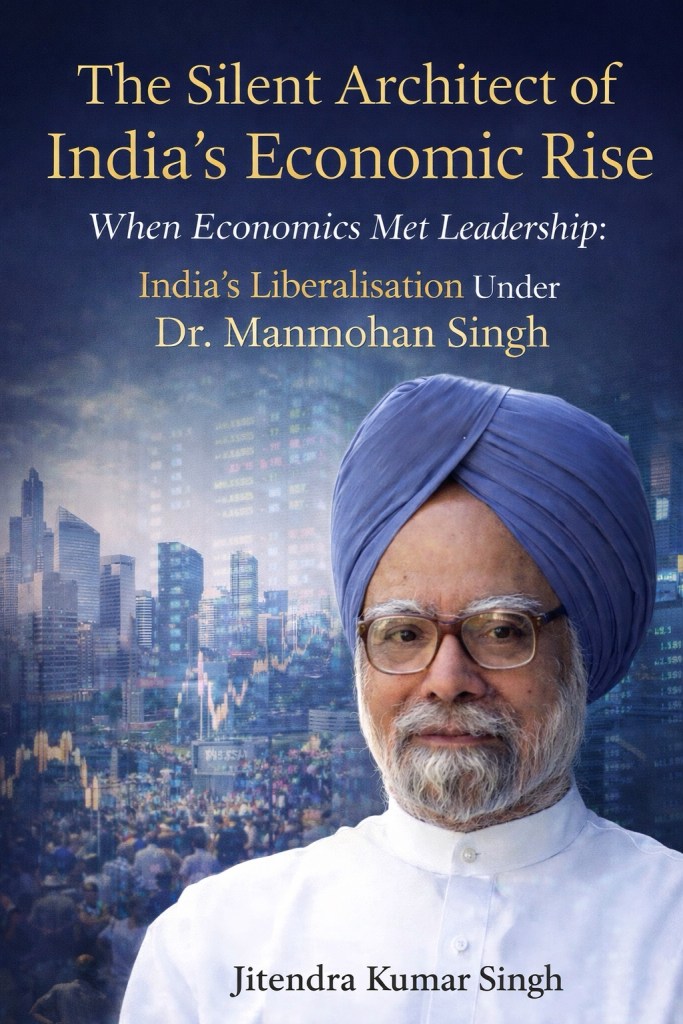
When Economics Met Leadership: India’s Liberalisation Under Dr. Manmohan Singh
Leadership at the Edge of Collapse
In 1991, India confronted one of the gravest economic crises in its post-independence history. Foreign exchange reserves had fallen to critically low levels, inflation was rising, and the country faced the real prospect of sovereign default. More than an economic emergency, the moment posed a profound question of leadership and governance: could a democratic state implement painful but necessary reforms without eroding political legitimacy?
The Crisis of 1991-Economic Triggers
Balance of Payments Crisis:
Foreign exchange reserves fell to less than USD 1 billion
High Fiscal Deficit: Exceeded 8% of GDP
External Shocks:
Gulf War oil price spike and decline in remittances
Rising Debt:
Growing dependence on external borrowing
Political Context
India experienced political instability between 1989 and 1991. When P.V. Narasimha Rao assumed office as Prime Minister in June 1991, the situation demanded immediate and decisive action.
India was compelled to pledge gold reserves abroad to secure emergency funding — a moment that symbolised the gravity of the crisis.
The Emergence of a Technocrat in Power
Dr. Manmohan Singh was appointed Finance Minister in 1991. His background included:
• Academic training at Oxford and Cambridge
• Former Governor of the Reserve Bank of India
• Chief Economic Adviser and Deputy Chairman of the Planning Commission
Singh believed the crisis was not merely cyclical but structural, requiring deep and irreversible reform.
In his 1991 Budget speech, he framed reform as historical inevitability:
“No power on earth can stop an idea whose time has come.”
At the centre of this turning point stood Dr. Manmohan Singh,
a technocrat with deep economic expertise but limited political capital.
His success lay not in charisma or coercion, but in aligning economic ideas, institutional reform, and political stewardship through what came to be known as the LPG model—Liberalisation, Privatisation, and Globalisation.
Background: India’s Pre-1991 Economic Model
From Independence until the late 1980s, India followed a state-led, inward-looking economic model, characterised by:
Central planning via Five-Year Plans
Extensive industrial licensing (Licence Raj)
Dominance of Public Sector Undertakings (PSUs)
High import tariffs and quantitative restrictions
Limited foreign investment
While this model helped establish basic industries and ensured self-reliance, it also led to:
Low productivity and inefficiency
Weak export competitiveness
Chronic fiscal deficits
Slow growth averaging around 3–3.5% annually
By the late 1980s, these structural weaknesses had become increasingly unsustainable.
Technocratic Leadership, Political Sponsorship, and the LPG Framework
A key question in governance studies is whether technocratic leadership can succeed without political sponsorship. India’s experience suggests it cannot.
While Dr. Singh designed the reform framework, it was Prime Minister P.V. Narasimha Rao’s political backing that allowed the LPG model to be implemented.
The LPG framework was not introduced as a single shock, but as a sequenced leadership strategy:
Reform Strategy: The LPG Framework
1. Liberalisation
Abolition of industrial licensing for most sectors,Removal of controls on capacity expansion,Simplification of regulatory approvals
Impact: Unleashed private entrepreneurship and reduced bureaucratic bottlenecks.
2. Privatisation
Reduced rent-seeking opportunities and political patronage by reducing government monopoly in non-strategic sectors
Initiation of PSU disinvestment
Greater reliance on market efficiency,
Impact: Improved efficiency and signalled a shift away from state dominance.
3. Globalisation
Sharp reduction in import tariffs
Opening of sectors to Foreign Direct Investment (FDI)
Integration into global trade systems
Impact: India transitioned from a closed economy to a globally connected one.
Globalisation imposed external discipline through global markets and competition.
Rao absorbed political risk and managed resistance, while Singh ensured economic coherence.
This division of roles highlights that policy frameworks succeed when expertise and authority work in tandem.
Crisis-Driven Reform and Democratic Ethics
Was it ethically justified to introduce LPG reforms during a crisis in a democracy? India’s answer was conditional yes.
The crisis created urgency, but reforms were implemented within constitutional and parliamentary norms.
Budgetary approval, legislative debate, and institutional consultation were maintained. Liberalisation and privatisation were phased, not imposed overnight; globalisation was selective, not indiscriminate.
Ethical legitimacy stemmed from intent and restraint.
The LPG model was not used to centralise power, but to decentralise economic decision-making. By reducing state control rather than expanding it, the reforms aligned economic efficiency with democratic accountability.
Institutional Governance and the Design of LPG Reforms
One of the most under-appreciated aspects of the LPG reforms is how they strengthened institutional governance.
Institutions such as the Reserve Bank of India and SEBI gained autonomy, shifting governance from personalities to processes. This institutionalisation was critical in legitimising reforms that were otherwise socially and politically costly.
The LPG model thus functioned not merely as an economic framework, but as a governance reform agenda.
Leadership During Crisis: Implementing LPG Without Social Rupture
The success of LPG reforms also depended on how they were led.
Leadership communication was honest but non-alarmist. Decisions were swift but consultative. Risks were managed through incremental liberalisation, gradual privatisation, and calibrated global integration.
This approach avoided social rupture while ensuring irreversibility.
The lesson is clear: strong governance is quiet, predictable, and institution-driven, not theatrical.
LPG Model in a Changing Political Environment
Would the LPG-style leadership succeed today?
The political context has evolved media intensity, polarisation, and identity politics have increased. However, the underlying principle remains relevant: complex economies require expert-led frameworks.
What may differ is the need for greater transparency, public engagement, and social cushioning alongside liberalisation.
The LPG model today would need to be more inclusive, but its core logic is efficiency through openness and competition remains intact.
Balancing Elected Authority and Expert Power in LPG Reforms
The LPG reforms illustrate a functional balance between elected authority and expert power.
Elected leaders retained final decision-making authority, ensuring democratic legitimacy.
Experts shaped policy content, ensuring technical soundness. Neither dominated; both depended on institutions.
Leadership Dynamics
Role of Prime Minister P.V. Narasimha Rao
Provided political cover despite a minority government
Managed internal party resistance
Shielded technocratic decision-making from populist backlash
Role of Dr. Manmohan Singh
Anchored reforms in economic logic rather than ideology
Communicated urgency without alarmism
Advanced incremental but irreversible change
This balance prevented technocratic overreach while insulating policy from populist reversal. It remains a critical governance lesson for reforming democracies.
Outcomes and Long-Term Impact of the LPG Model
In the short term, LPG reforms stabilised India’s economy, restored foreign exchange reserves, and revived growth.
In the long term, they transformed India’s economic structure expanding services, attracting investment, and integrating India into global value chains.
Yet limitations persisted: uneven social outcomes, delayed labour and agricultural reforms, and implementation challenges at the state level.
These underscore that LPG was a foundation, not a final destination.
Leadership and Governance Lessons from the LPG Experience
1. Policy frameworks need political sponsorship to succeed.
2. Crisis enables reform, but legitimacy comes from democratic process.
3. LPG succeeded because it reduced discretion and strengthened institutions.
4. Expertise and democracy can reinforce each other.
5. Reform sustainability depends on balance, not dominance.
India’s 1991 liberalisation was not merely an economic shift but it was a leadership and governance transformation.
Through the LPG model,
Dr. Manmohan Singh demonstrated how quiet competence, institutional respect, and political alignment can reshape a nation’s destiny.
When economics met leadership, India did more than survive a crisis it redefined its future.
Conclusion:
Governance works best when it is quiet, rule-bound, and institution-led rather than loud, performative, or overly focused on dashboards and optics.
References
Ahluwalia, M. S. (2002). Economic Reforms in India Since 1991: Has Gradualism Worked? Journal of Economic Perspectives, 16(3), 67–88.
Ahluwalia, M. S. (2019). India’s Economic Reforms: Reflections and Lessons. Oxford University Press.
Bhagwati, J. (1993). India in Transition: Freeing the Economy. Oxford University Press.
Drèze, J., & Sen, A. (2013). An Uncertain Glory: India and Its Contradictions. Princeton University Press.
Fukuyama, F. (2014). Political Order and Political Decay. Farrar, Straus and Giroux.
Government of India. (1991). Economic Survey 1991–92. Ministry of Finance.
Jenkins, R. (1999). Democratic Politics and Economic Reform in India. Cambridge University Press.
North, D. C. (1990). Institutions, Institutional Change and Economic Performance. Cambridge University Press.
Panagariya, A. (2008). India: The Emerging Giant. Oxford University Press.
Reserve Bank of India. (1993). Report on Currency and Finance. RBI.
Rodrik, D. (2007). One Economics, Many Recipes. Princeton University Press.
Ruggie, J. G. (1982). International Regimes, Transactions, and Change. International Organization, 36(2), 379–415.
Singh, M. (1991). Budget Speech, 1991–92. Government of India.
Stiglitz, J. E. (2002). Globalization and Its Discontents. W.W. Norton.
Weber, M. (1946). From Max Weber: Essays in Sociology. Oxford University Press.

Leave a comment