
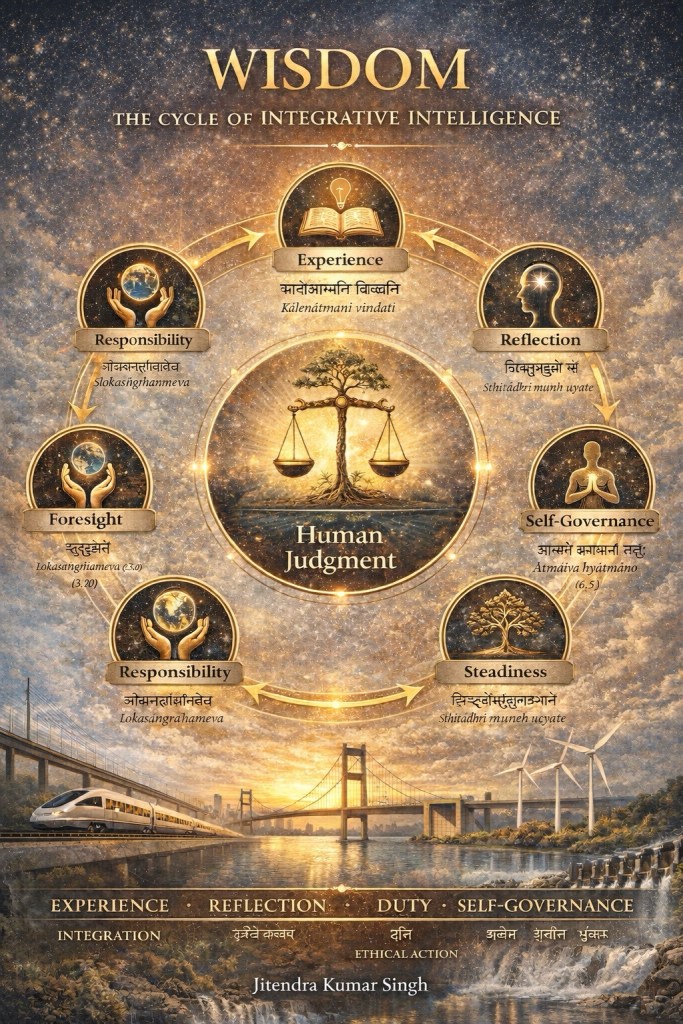
In an era dominated by artificial intelligence, data acceleration, and fragmented knowledge systems, humanity faces a paradox: unprecedented access to information but diminishing coherence of understanding.
This article presents Integrative Intelligence as a higher-order cognitive and ethical framework that synthesizes knowledge, experience, values, and foresight. Unlike intelligence measured by speed, memory, or computational power, Integrative Intelligence represents the capacity to align truth with purpose, action with ethics, and progress with sustainability.
1. Beyond Intelligence and Knowledge
Modern civilization often equates intelligence with problem-solving ability and knowledge with information accumulation.
Yet global crises climate instability, polarization, technological misuse, and ethical breakdowns show that
capability without moral direction can be destructive.
The Bhagavad Gita offers a framework for mature judgment in action clarity, restraint, duty, and steadiness under pressure. These principles align with global traditions of ethical reasoning found in Aristotle, Confucius, and modern responsibility ethics.
2. Defining Wisdom-Integrative Intelligence
Integrative Intelligence can be defined as:
A human capacity that harmonizes cognitive, emotional, ethical, cultural, and temporal dimensions to guide decisions toward long-term collective well-being.
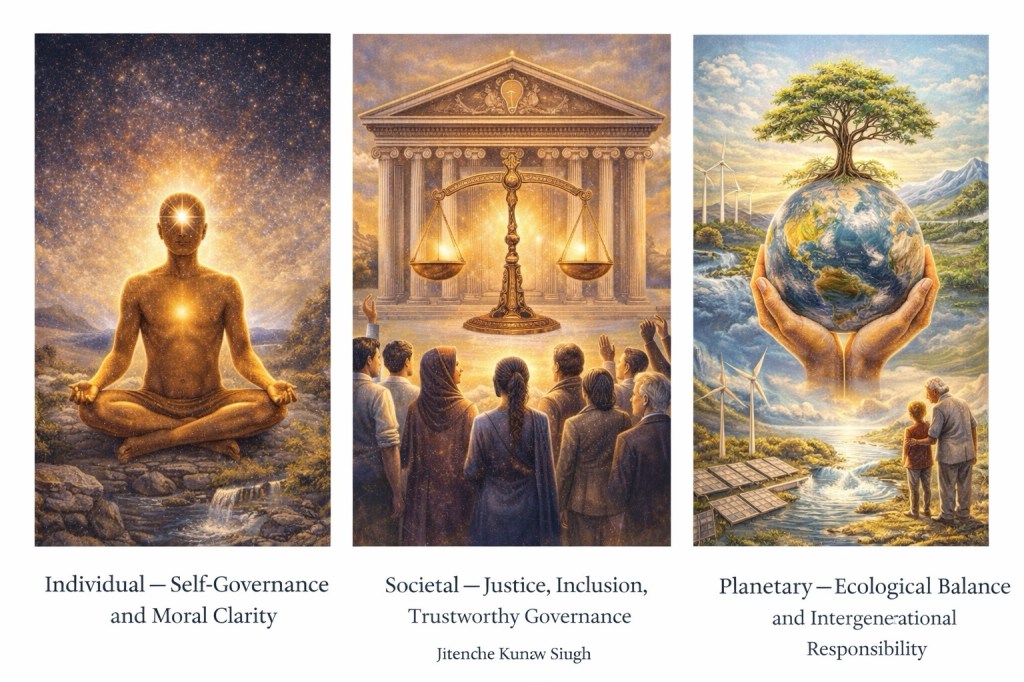
It operates simultaneously at three levels:
Individual — self-governance and moral clarity
Societal — justice, inclusion, trustworthy governance
Planetary — ecological balance and intergenerational responsibility
3. Core Dimensions of Integrative Intelligence
3.1 Cognitive Integration
This capacity unites analytical reasoning, systems thinking, and contextual understanding.
Wisdom unites:
Analytical reasoning
Systems thinking
Contextual understanding
It recognizes that isolated facts mislead when disconnected from relationships and consequences.
Bhagavad Gita 2.41
व्यवसायात्मिका बुद्धिरेकेह कुरुनन्दन।
बहुशाखा ह्यनन्ताश्च बुद्धयोऽव्यवसायिनाम्॥
vyavasāyātmikā buddhir ekeha kuru-nandana
bahu-śākhā hy anantāś ca buddhayo’vyavasāyinām
Meaning
A focused and integrated judgment is unified in purpose, while scattered judgment pursues countless, conflicting directions.
Leadership Insight:
Ethical clarity requires coherence of intent, not fragmented ambition.
This emphasizes unified judgment rather than scattered thinking.
3.2 Emotional and Ethical Integration
Ethical collapse often begins with emotional imbalance—fear, attachment, anger, or desire. Wisdom stabilizes emotion while preserving empathy.
Bhagavad Gita 2.64
रागद्वेषविमुक्तैस्तु विषयानिन्द्रियैश्चरन्।
आत्मवश्यैर्विधेयात्मा प्रसादमधिगच्छति॥
rāga-dveṣa-vimuktais tu viṣayān indriyaiś caran
ātma-vaśyair vidheyātmā prasādam adhigacchati
Meaning :
One who acts with self-control, free from excessive attachment and aversion, attains inner calm and clarity.
Leadership Insight:
Emotional regulation is the foundation of ethical judgment.
This highlights inner regulation as the basis of clarity.
3.3 Temporal Integration
Short-term optimization dominates many decisions.
short-term optimization,
Wisdom incorporates:
Historical insight
Present realism
Future foresight
Integrative Intelligence expands time horizons learning from history, acting responsibly in the present, and anticipating long-term effects.
Bhagavad Gita 2.48
योगस्थः कुरु कर्माणि सङ्गं त्यक्त्वा धनञ्जय।
सिद्ध्यसिद्ध्योः समो भूत्वा समत्वं योग उच्यते॥
yoga-sthaḥ kuru karmāṇi saṅgaṁ tyaktvā dhanañjaya
siddhy-asiddhyoḥ samo bhūtvā samatvaṁ yoga ucyate
Meaning :
Perform your responsibilities with balance, without attachment to success or failure. Such equilibrium is disciplined action.
Leadership Insight:
Ethics demands steadiness, not emotional dependence on outcomes.
This guides balance under uncertainty.
3.4 Cultural and Human Integration
Plural societies require decisions that respect diversity while protecting shared human values.
Bhagavad Gita 6.30
यो मां पश्यति सर्वत्र सर्वं च मयि पश्यति।
तस्याहं न प्रणश्यामि स च मे न प्रणश्यति॥
yo māṁ paśyati sarvatra sarvaṁ ca mayi paśyati
tasyāhaṁ na praṇaśyāmi sa ca me na praṇaśyati
Meaning :
One who perceives unity across all beings and situations remains aligned with the larger order and does not lose perspective.
Leadership Insight:
Seeing interconnectedness prevents exclusion, injustice, and dehumanization.
This supports a unifying, non-dehumanizing perspective.
4. How Wisdom Is Gained and Achieved
Wisdom is not inherited as a fixed trait, nor achieved through information alone. It is cultivated and built like an inner infrastructure through repeated integration of experience, reflection, and ethical action. It grows through a few identifiable pathways:
4.1 Experience Transformed into Understanding
Experience alone does not mature a person; it can also reinforce fear, ego, or bias. Wisdom develops when experience is processed through reflection:
What happened? Why did it happen? What was my role and responsibility? What are the second-order effects?
This turns life events into insight rather than memory.
Bhagavad Gita 4.38
न हि ज्ञानेन सदृशं पवित्रमिह विद्यते।
तत्स्वयं योगसंसिद्धः कालेनात्मनि विन्दति॥
na hi jñānena sadṛśaṁ pavitram iha vidyate
tat svayaṁ yoga-saṁsiddhaḥ kālenātmani vindati
Meaning :
Nothing purifies understanding more than true insight, which unfolds through disciplined practice and time.
असक्तो ह्याचरन्कर्म परमाप्नोति पूरुषः॥ (3.19)
Leadership Insight:
Mature judgment is cultivated, not acquired instantly.
Bhagavad Gita 3.19
4.2 Duty Without Self-Interest
(Integration of Multiple Perspectives)
Wisdom expands when one can hold more than one truth at a time:
logic and compassion rights and duties efficiency and justice innovation and safety
This integrative capacity prevents moral collapse caused by one-dimensional thinking.
Attachment to reward distorts judgment; responsibility stabilizes it.
तस्मादसक्तः सततं कार्यं कर्म समाचर।
tasmād asaktaḥ satataṁ kāryaṁ karma samācara
asakto hy ācaran karma param āpnoti pūruṣaḥ
Meaning ;
Therefore, perform your duty consistently without attachment to personal gain; such action leads to the highest outcome.
Leadership Insight:
Integrity arises when responsibility outweighs self-interest.
4.3 Self-Governance Before External Control
(Humility and Self-Correction)
Wisdom requires a self-auditing mind—the capacity to revise beliefs and admit error. This includes:
learning from criticism updating decisions when evidence changes recognizing blind spots and biases separating identity from opinion
Self-correction is a hallmark of higher-order intelligence.
No system can replace inner restraint.
Bhagavad Gita 6.5
उद्धरेदात्मनाऽत्मानं नात्मानमवसादयेत्।
आत्मैव ह्यात्मनो बन्धुरात्मैव रिपुरात्मनः॥ (6.5)
uddhared ātmanātmānaṁ nātmānam avasādayet
ātmaiva hy ātmano bandhur ātmaiva ripur ātmanaḥ
Meaning :
One must elevate oneself through self-governance; the same inner faculty can either strengthen or undermine a person.
Leadership Insight:
Self-regulation is the first safeguard against ethical failure.
4.4 Steadiness Under Pressure
(Ethical Practice Under Pressure)
Clarity is tested under crisis, not comfort.
Wisdom is gained when a person consistently chooses:
fairness over convenience
truth over popularity responsibility over self-interest
long-term good over short-term gain
Over time, ethical repetition becomes character, and character becomes reliable leadership.
Bhagavad Gita 2.56
दुःखेष्वनुद्विग्नमनाः सुखेषु विगतस्पृहः।
वीतरागभयक्रोधः स्थितधीर्मुनिरुच्यते॥ (2.56)
duḥkheṣv anudvigna-manāḥ sukheṣu vigata-spṛhaḥ
vīta-rāga-bhaya-krodhaḥ sthita-dhīr munir ucyate
Meaning :
One who remains steady in adversity, unattached in comfort, and free from fear and anger possesses stable judgment.
Leadership Insight:
Ethical consistency is proven under pressure, not comfort.
4.5 Responsibility for Collective Order
(Service and Responsibility as a Training Ground)
Maturity expands with accountability for others.
Wisdom deepens when a person carries responsibility for others—teams, communities, institutions, or future generations. Service forces the mind to think beyond personal gain and into:
accountability consequences sustainability trust
Responsibility is not a burden alone; it is a teacher.
Bhagavad Gita 3.20
कर्मणैव हि संसिद्धिमास्थिता जनकादयः।
लोकसङ्ग्रहमेवापि सम्पश्यन्कर्तुमर्हसि॥
karmaṇaiva hi saṁsiddhim āsthitā janakādayaḥ
loka-saṅgraham evāpi sampaśyan kartum arhasi
Meaning :
Excellence is attained through responsible action, as demonstrated by exemplary leaders who acted for the stability of society.
Leadership Insight:
True leadership is defined by responsibility for collective order.
In summary: Wisdom is achieved through a lifelong cycle:
Cycle of development:
Experience → Reflection → Duty → Self-Governance → Steadiness → Responsibility → Foresight
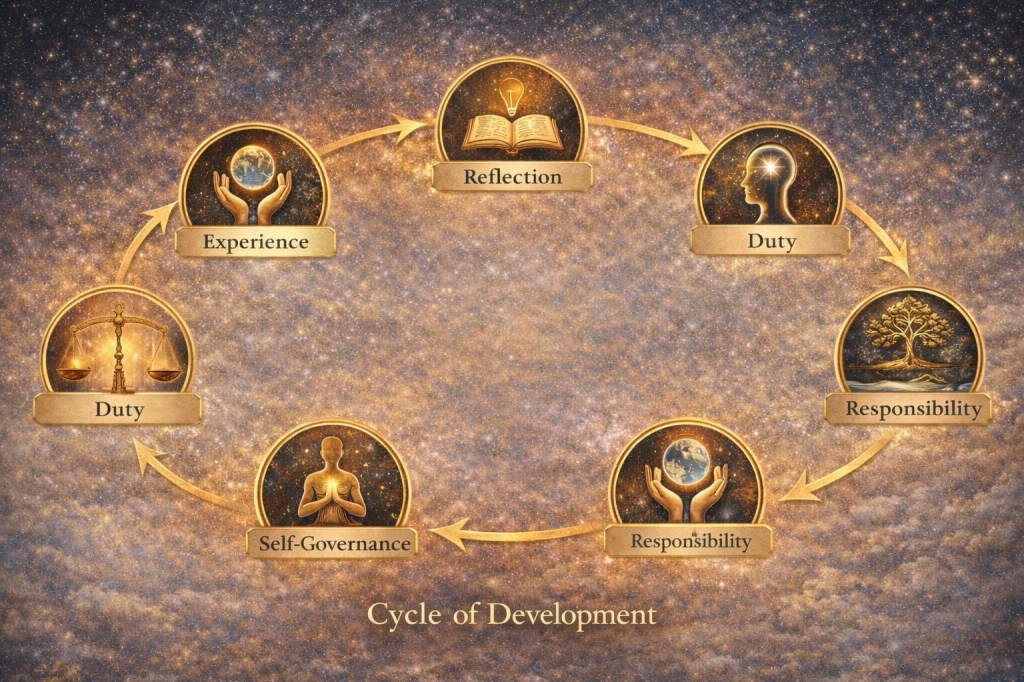
The more consistently this cycle is practiced, the more stable and trustworthy a person’s judgment becomes especially in complex, high-stakes environments.
5. Wisdom in the Age of Artificial Intelligence
As artificial intelligence advances, a critical distinction must be made:
AI can process intelligence Only humans can embody wisdom
Wisdom Wisdom serves as the ethical governor of technological power. It ensures that AI development aligns with human values, social equity, and ecological sustainability rather than profit or control alone.
AI optimizes objectives; humans must define legitimate ends. Wisdom ensures that power, speed, and automation remain aligned with dignity, fairness, and accountability.
Without Wisdom, AI risks becoming efficiently dangerous. With it, AI becomes a tool for collective upliftment
6. From Knowledge Societies to Coherent Civilizations
(Applications Across Global Domains)
6.1 Governance and Leadership
Leaders guided by Wisdom Wisdom prioritize:
long-term public interest over short-term political gains evidence combined with ethical reasoning inclusive decision-making
6.2 Education
Education systems must move beyond rote learning to cultivate:
critical reflection moral reasoning interdisciplinary synthesis
Wisdom Wisdom transforms education from skill-training to human development.
6.3 Sustainable Development
Economic growth without wisdom leads to inequality and environmental collapse. Wisdom Wisdom reframes development as balanced prosperity, integrating economic, social, and ecological goals.
The next stage of human progress measures success not by output alone, but by resilience, trust, balance, and long-term well-being.
7. From Knowledge Societies to Wisdom Civilizations
Human history has progressed through stages:
Agrarian societies Industrial societies Knowledge societies
The next evolutionary step is the Wisdom Civilization, where progress is measured not by output alone, but by harmony, resilience, and meaning.
Wisdom Wisdom becomes the operating intelligence of such a civilization.
8. Reflection Summary
In a world overwhelmed by complexity, the greatest deficit is not intelligence, data, or technology it is integration.
Wisdom offers a unifying framework that reconnects knowledge with values, power with responsibility, and progress with purpose.
The future does not belong to the most intelligent systems, but to the wisest ones

Leave a comment