
An Ancient Insight into Modern Stress and Confusion
Social Perspective of Bhagavad Gita 2.62–2.63
(A Framework for Social Behavior, Media Influence, and Collective Decline)
The Bhagavad Gita describes a psychological chain reaction that begins silently and ends in self-destruction:
ध्यायतो विषयान्पुंसः सङ्गस्तेषूपजायते ।
सङ्गात्सञ्जायते कामः कामात्क्रोधोऽभिजायते
करोधाद्भवति संमोहः संमोहात्स्मृतिविभ्रमः ।
स्मृतिभ्रंशाद्बुद्धिनाशो बुद्धिनाशात्प्रणश्यति ॥
Dhyāyato viṣayān puṁsaḥ saṅgas teṣūpajāyate |
Saṅgāt sañjāyate kāmaḥ kāmāt krodho’bhijāyate ||
Krodhād bhavati saṁmohaḥ saṁmohāt smṛti-vibhramaḥ |
Smṛti-bhraṁśād buddhi-nāśo buddhi-nāśāt praṇaśyati ||
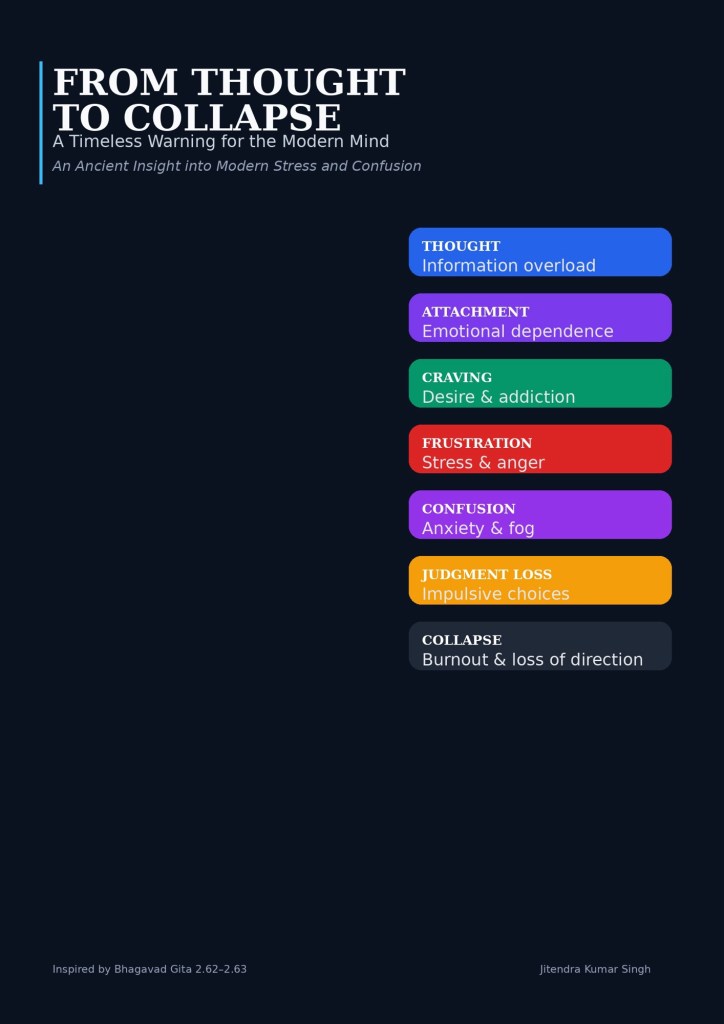
Repeated thinking about sense objects leads to attachment.
Attachment leads to desire.
Desire leads to anger.
Anger leads to delusion.
Delusion leads to loss of memory.
Loss of memory leads to destruction of judgment.
And when judgment is destroyed, the person collapses.
(Gita 2.62–2.63)
This ancient sequence explains many modern problems with remarkable accuracy.
1. Social Media: The Starting Point of Constant Thinking
Social media trains the mind to continuously think about external stimuli:
likes validation comparison pleasure outrage
Endless scrolling is the modern form of “dhyāyataḥ viṣayān” — constant contemplation of sense objects.
The mind becomes attached before we realize it.
2. Attachment Turns into Desire and Addiction
Repeated exposure creates attachment:
desire for attention desire for approval desire for pleasure
Soon, desire becomes dependency.
This is how:
phone addiction dopamine addiction content addiction
are formed.
The Gita calls this stage kāma — craving that demands satisfaction.
3. Desire Becomes Anger and Frustration
When desires are blocked:
low engagement unmet expectations criticism delays
anger appears.
This anger may not always be explosive —
often it shows as irritation, impatience, or resentment.
Modern stress is often unexpressed anger.
4. Anger Creates Mental Confusion and Anxiety
Anger clouds judgment.
We react instead of thinking.
This leads to:
impulsive decisions harmful words regret
The Gita calls this saṁmoha — mental delusion.
An anxious mind is a confused mind.
5. Loss of Memory: Forgetting Values and Purpose
Under stress and emotional overload, we forget:
our values our long-term goals past lessons
We know what is right — yet fail to act on it.
This is smṛti-vibhramaḥ — loss of inner memory.
6. Destruction of Judgment: The Real Collapse
When judgment fails:
decisions become impulsive self-control disappears life becomes reactive
This is the stage where:
relationships break careers suffer health declines
The Gita’s final word “praṇaśyati” does not mean instant destruction,
but loss of inner direction.
The Core Lesson for Today’s modern World
The first uncontrolled thought is the real danger.
Modern life does not destroy us unmanaged attention does.
Practical Takeaway
Control attention before it becomes attachment Pause desire before it becomes anger Calm anger before it becomes anxiety Protect clarity before judgment collapses
Management Perspective of Bhagavad Gita 2.62–2.63
(A Framework for Decision-Making, Leadership, and Organizational Health)
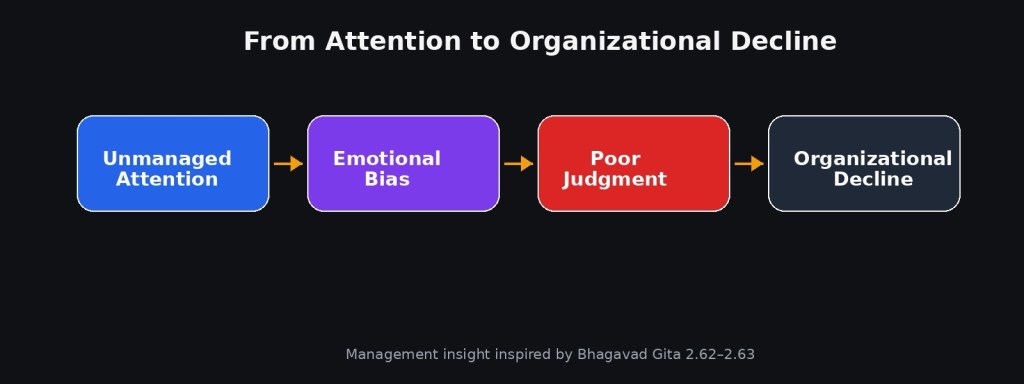
The Gita presents a cause–effect chain of human behavior that is extremely relevant to management and leadership. It explains how unmanaged attention and emotions lead to poor decisions and organizational failure.
1 Constant Thinking → Attention Mismanagement
(Dhyāyato viṣayān)
Management Meaning:
When managers and employees are constantly preoccupied with:
targets competition incentives social comparison digital distractions
their attention gets hijacked.
Impact at work:
Reduced focus Shallow thinking Reactive behavior
Management lesson:
Attention is the first asset a leader must manage.
2 Attachment → Bias and Loss of Objectivity
(Saṅgaḥ)
Management Meaning:
Attachment forms when leaders:
over-identify with outcomes cling to personal ideas become emotionally invested in positions or ego
Impact at work:
Resistance to feedback Micromanagement Conflict of interest
Management lesson:
Good leaders stay committed to goals, not attached to ego.
3 Desire / Craving → Unethical Pressure
(Kāmaḥ)
Management Meaning:
Desire appears as:
hunger for growth at any cost promotion obsession short-term profit focus
Impact at work:
Ethical compromises Unrealistic deadlines Employee burnout
Management lesson:
Uncontrolled ambition weakens sustainable performance.
4 Anger / Frustration → Toxic Leadership
(Krodhaḥ)
Management Meaning:
When desires are blocked:
missed targets delays resistance from teams
anger emerges.
Impact at work:
Harsh communication Fear-based culture Low psychological safety
Management lesson:
Anger destroys trust faster than failure destroys results.
5 Confusion → Strategic Drift
(Saṁmohaḥ)
Management Meaning:
Anger clouds thinking, leading to:
impulsive decisions unclear priorities constant strategy changes
Impact at work:
Team confusion Execution failure Loss of direction
Management lesson:
Emotional clarity precedes strategic clarity.
6 Loss of Memory → Forgetting Values & Vision
(Smṛti-vibhramaḥ)
Management Meaning:
Under pressure, leaders forget:
core values long-term vision lessons from past failures
Impact at work:
Culture erosion Repeated mistakes Loss of organizational identity
Management lesson:
Values remembered under pressure define true leadership.
7 Destruction of Judgment → Poor Decisions
(Buddhi-nāśaḥ)
Management Meaning:
This is the most dangerous stage:
decisions become reactive risk assessment fails communication breaks down
Impact at work:
Bad investments Talent loss Crisis escalation
Management lesson:
Judgment collapses before organizations collapse.
8 Collapse → Organizational Failure
(Praṇaśyati)
Management Meaning:
Collapse does not mean instant failure.
It means:
declining morale loss of trust burnout reputational damage
Impact at work:
Organizations fail internally first, then externally.
Management lesson:
Most corporate failures are psychological before they are financial.
Core Management Insight
Organizations don’t fail suddenly.
They decline when attention goes unmanaged.
Practical Takeaways for Managers & Leaders
Manage attention, not just time Reduce ego-based attachment Balance ambition with ethics Respond, don’t react Protect clarity under pressure Anchor decisions in values
Modern Leadership Principle (From the Gita)
The quality of leadership depends on the clarity of the leader’s mind.
This is why the Bhagavad Gita remains a timeless management manual, not just a spiritual text.
Closing Reflection
Thousands of years ago, the Gita mapped the human mind.
Today, technology accelerates the same process.
The solution remains the same:
Awareness at the beginning prevents collapse at the end.

Leave a comment