
Why meaningful leadership often begins in solitude
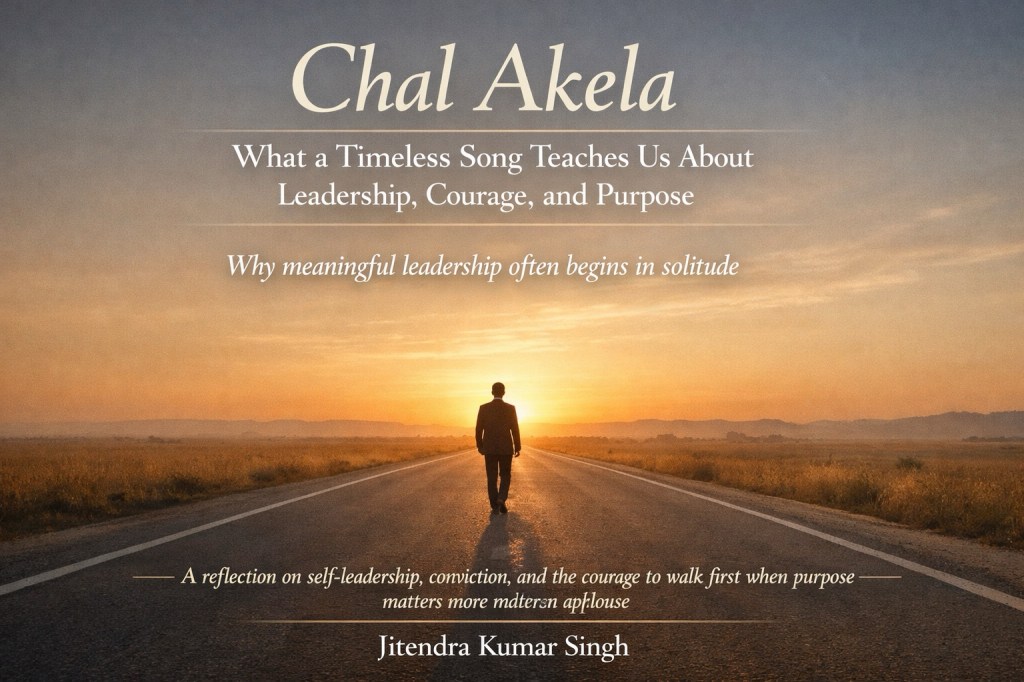
Listen to the timeless song “Chal Akela (Chal Akela Chal Akela)” on the official YouTube channel:
👉 https://music.youtube.com/watch?v=ItwBtK0Y2fA
In every era, certain works of art transcend entertainment and become guides for life. “Chal Akela (Chal Akela Chal Akela)” is one such song. Though simple in words and melody, its message carries extraordinary depth. It speaks to the human condition, especially to those who choose paths of responsibility, leadership, and purpose.
In the world of management and leadership, where uncertainty, pressure, and loneliness are constant companions, the philosophy behind Chal Akela feels strikingly relevant. The song is not merely about walking alone it is about leading oneself when no one else is ready to follow.
Leadership Begins Where the Crowd Ends (Chal akela chal akela )
One of the strongest ideas conveyed by Chal Akela is that leadership often begins in solitude. Popular narratives celebrate leaders when they are surrounded by supporters, success stories, and applause. However, the reality is far more complex. Most meaningful leadership decisions are taken in isolation, long before results are visible.
In organisations , leaders are expected to take responsibility even when outcomes are uncertain. At such moments, approval is rare, advice is conflicting, and clarity must come from within. The song reminds us that waiting for collective agreement can delay necessary action. Those who walk first often walk alone.
Great leaders in business, governance, and social change did not begin their journeys with consensus. They began with conviction.
The Courage to Leave the Crowd Behind (Tera mela pichhe chhuta rahi”)
The metaphor of leaving the “fair” behind is deeply symbolic. A fair represents noise, comfort, familiarity, and short-term pleasure. In management terms, it reflects distractions such as popularity, trends, and safe choices.
Progress requires detachment. Whether it is restructuring an organization, introducing innovation, or standing firm on ethical principles, leaders must often distance themselves from mass opinion. This detachment is not arrogance; it is strategic clarity.
Managers who chase approval frequently lose direction. Leaders who prioritize purpose over popularity build sustainable systems. The song subtly teaches that growth demands sacrifice, and sacrifice begins with letting go.
The Long Road Mindset: Thinking Beyond Short-Term Gains
Another powerful theme is the idea of long and demanding roads. In today’s results-driven culture, leaders face constant pressure for quick wins. Quarterly targets, immediate visibility, and short-term metrics dominate decision-making.
However, lasting success whether in infrastructure, startups, institutions, or personal careers requires patience.
The long road builds resilience, experience, and wisdom. It tests commitment and filters intent.
Managers who understand this do not panic during slow phases.
They invest in people, systems, and values, knowing that strong foundations take time.
Chal Akela reinforces the idea that important destinations are never reached easily or quickly.
Pain as a Teacher, Not an Enemy (Yahan dukhde sahne ke vaaste- This path is meant for bearing pain)
Leadership is often romanticised, but those who have led know that it comes with emotional and mental strain. Criticism, doubt, resistance, and failure are unavoidable.
The song acknowledges suffering not as a misfortune, but as a companion on the journey.
From a management perspective, this is a crucial lesson.
Leaders who avoid discomfort avoid growth. Those who embrace challenges develop depth and credibility. Pain refines judgment and strengthens character.
In high-responsibility roles, leaders frequently absorb stress so their teams can function effectively. This invisible burden is rarely acknowledged but deeply impactful.
The song quietly validates this experience and reminds leaders that struggle is not a sign of weakness, but of responsibility.
Self-Leadership Before Leading Others
Perhaps the most important management lesson from Chal Akela is the emphasis on self-leadership. Before one can lead teams, organizations, or movements, one must lead oneself.
Self-leadership involves:
Clarity of values Emotional discipline Moral courage Consistency between thought and action
When external guidance is absent, internal discipline becomes the guiding force.
Leaders who lack self-leadership often depend excessively on validation, authority, or hierarchy.
Those who cultivate inner strength remain stable even in chaos.
The song’s call to walk alone is ultimately a call to trust one’s inner compass.
Ethics, Purpose, and the Inner Calling (Hazaron meel lambe raste tujhko bulate hai kaun sa wo)
Beyond management techniques, Chal Akela carries a profound moral message. It asks a fundamental question: What truly calls you forward?
In leadership, ethical dilemmas are unavoidable. Short-term gains often conflict with long-term integrity.
At such moments, rules may be unclear, and advice may be self-serving. Only purpose and values provide direction.
Organizations led by purpose-driven leaders inspire trust, loyalty, and resilience. Employees follow leaders they respect, not just those they report to. Ethical leadership creates cultures that survive crises.
The song reminds us that leadership without moral clarity is hollow, and success without integrity is fragile.
The Change Agent’s Reality
Every change agent experiences resistance.
Systems resist disruption, people resist uncertainty, and cultures resist reform. Those who challenge the status quo are often misunderstood before they are appreciated.
The imagery of walking alone reflects this reality.
Change begins with discomfort. Leaders must move forward despite skepticism, knowing that acceptance often follows results.
From infrastructure development to organizational transformation, meaningful change requires the courage to stand firm when support is minimal. The song offers quiet encouragement to those navigating this difficult phase.
Relevance in Today’s Professional World
In an age of constant comparison, social validation, and instant feedback, the philosophy of Chal Akela feels almost countercultural. Yet, it is precisely this mindset that modern leaders need.
Entrepreneurs navigating uncertainty Managers handling unpopular but necessary decisions Professionals choosing ethics over convenience Leaders building institutions for the long term
All of them walk versions of this solitary path.
Song Reflection
Chal Akela is not a song of isolation; it is a song of responsibility.
It does not glorify loneliness but prepares the individual for it. It teaches that those who walk alone with purpose eventually create paths that others can follow.
Chal Akela is not merely a song to be heard; it is a mindset to be lived. Its message reminds us that progress often begins in silence, long before recognition or agreement appears.
The journey it speaks of is not easy, but it is honest rooted in responsibility, endurance, and inner clarity.
Walking Alone to Create Paths for Others
In management and leadership, solitude is often the price of vision. Those who accept this truth lead with clarity, courage, and compassion.
Ultimately, the song leaves us with a timeless truth:
The world is shaped not by those who wait for company, but by those who move forward when no one else will.

Leave a comment