
Overcoming Deep-Seated Inferiority Across Personal, Academic, and Physical Domains
- Introduction
Deep-seated feelings of inferiority often originate in early life and become embedded within an individual’s self-concept. When inferiority is internalized across personal background, academic performance, and physical appearance, it can shape emotional responses, social behavior, and even intellectual engagement throughout adulthood.
This article examines how inferiority functions as a self-perpetuating psychological syndrome and proposes Reauthoring the self as a coherent framework for overcoming it.
Drawing upon Adlerian psychology, cognitive-behavioral principles, existential phenomenology, and narrative therapy, it argues that healing requires not denial of the past, but a conscious rewriting of one’s self-narrative into one grounded in agency and lived evidence.
It is tempting to assume that beliefs about the self, about other people, and about life are formed mainly through rational reflection. Yet psychological and philosophical traditions repeatedly show that belief is frequently shaped by emotional history, social experience, and self-interpretation.
In particular, inferiority is not merely an occasional feeling; it can become a stable “lens” through which the person interprets worth, belonging, and possibility.
Adler’s Individual Psychology treats inferiority feelings as fundamental to human development and potentially central to later neurosis or maladaptive styles of life when they become rigid and compensatory.
This article focuses on inferiority concentrated in three domains—personal background, academic performance, and physical appearance and shows how it can affect a person’s whole life. It then proposes a multi-level method of recovery: reauthoring the self, a concept aligned strongly with narrative therapy’s emphasis on restorying life experiences and reclaiming authorship over identity.
2. The Psychological Architecture of Inferiority
2.1 Personal background
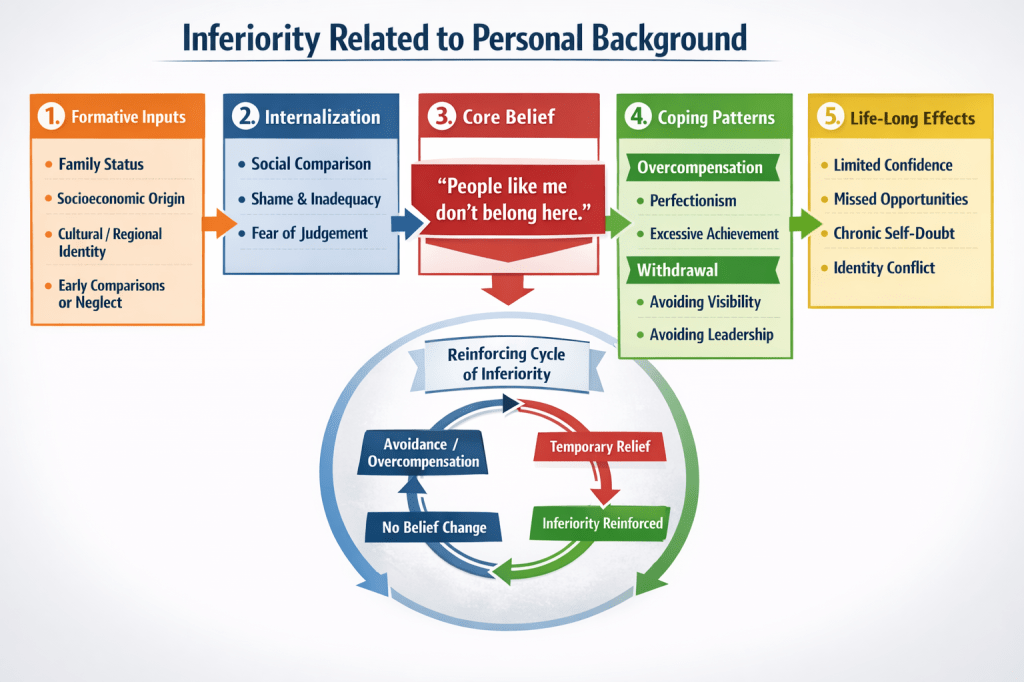
Inferiority related to personal background often reflects shame based beliefs about origin and belonging: “people like me do not fit here.” Over time, this can produce avoidance of visibility, reluctance to speak with confidence, and a chronic sensitivity to imagined social evaluation.
Adlerian theory emphasizes the social embeddedness of the self and the way early interpretations of one’s position in the world can shape life-patterns.
2.2 Academic performance
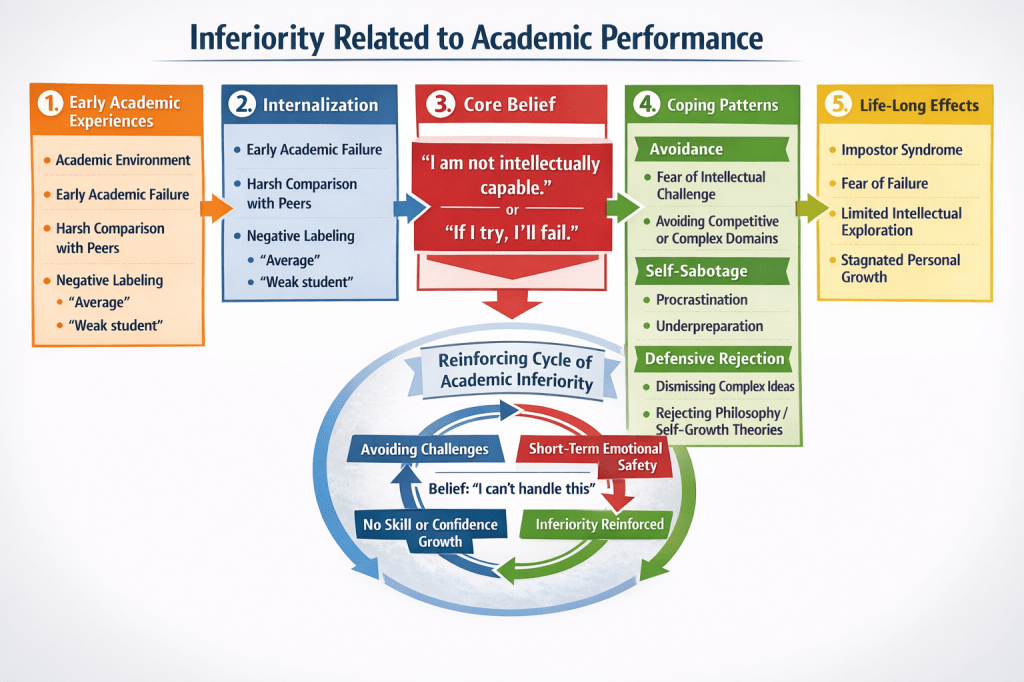
Academic inferiority may begin with early failure, comparison, or labeling, later developing into intellectual self-doubt and fear of challenge.
Cognitive-behavioral theory (CBT) is especially relevant here: it identifies how negative automatic thoughts and underlying beliefs shape emotion and behavior, often maintaining helplessness and avoidance.
In Beck’s cognitive model, distorted interpretations can systematically reinforce depressed or defeated self-views, making trying itself feel threatening.
2.3 Physical appearance
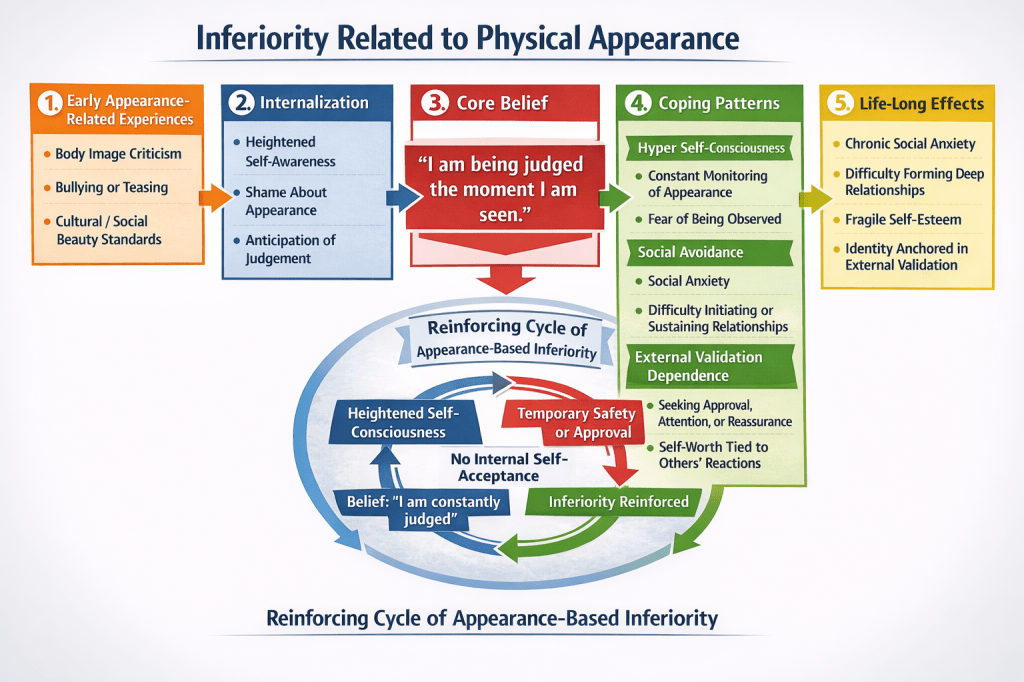
Appearance based inferiority often produces hyper self-consciousness and a heightened awareness of being watched. Sartre’s phenomenological analysis of being seen often discussed through the Look captures how a person can experience themselves as an object under another’s gaze, which intensifies shame and self-monitoring.
This existential dynamic is not merely social discomfort; it becomes a mode of self-relation.
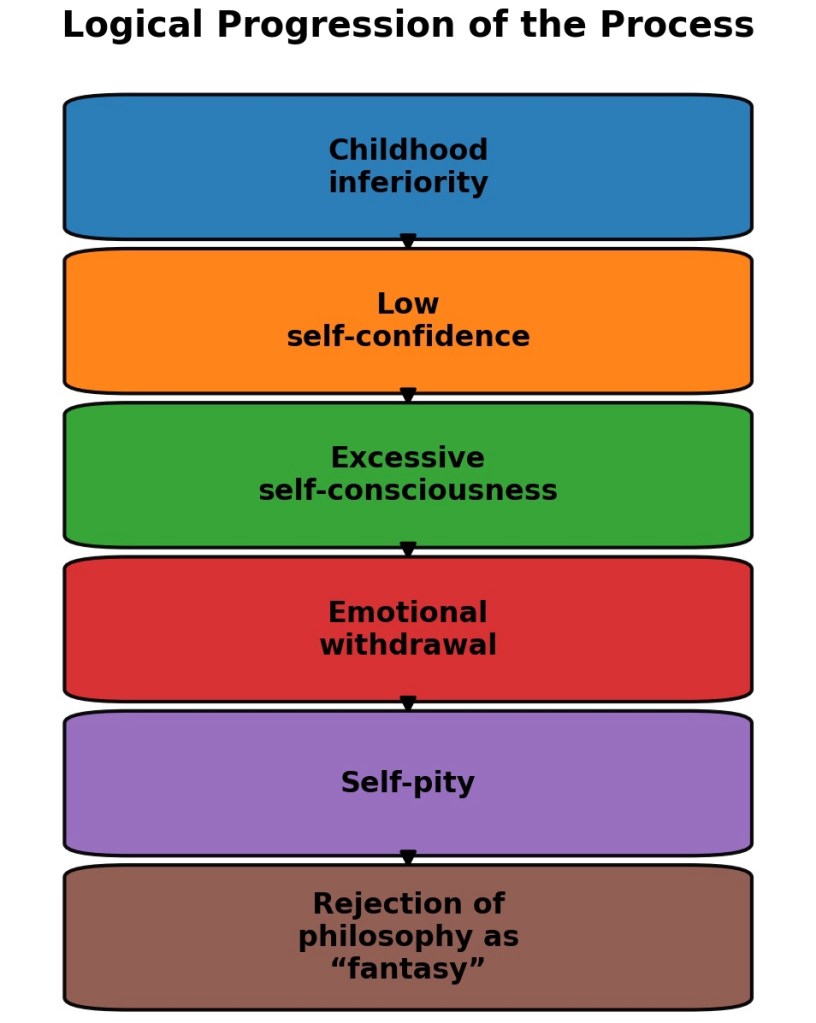
3. Life-Wide Consequences: Why Inferiority Becomes a Syndrome
When inferiority operates across multiple domains, it becomes self-reinforcing:
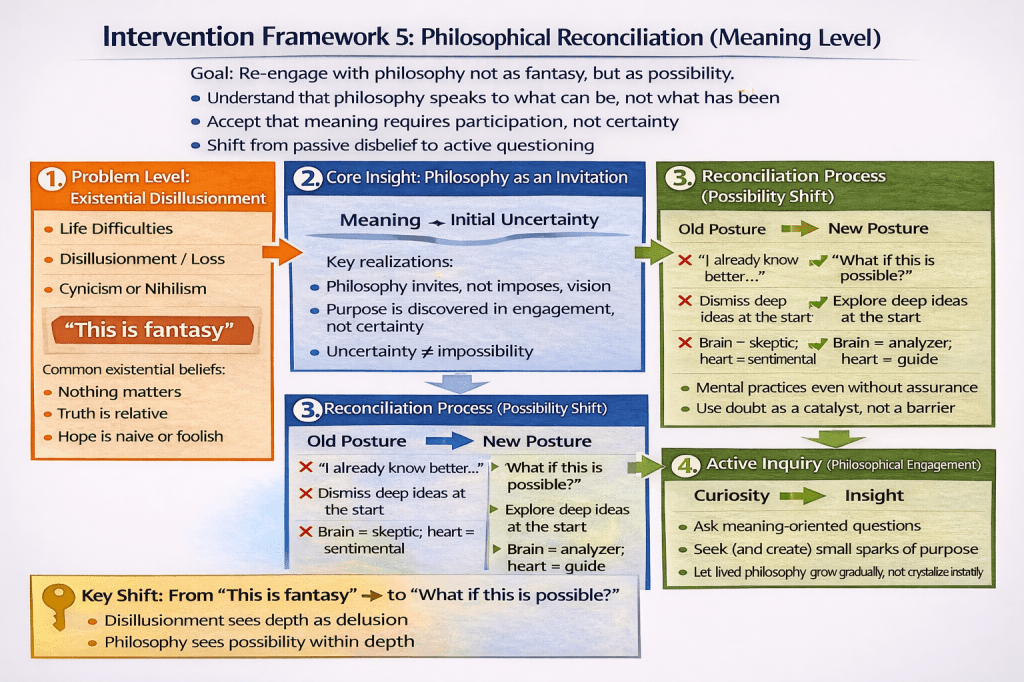
Psychological: persistent low self-confidence, chronic self-doubt Social: withdrawal, defensiveness, over-interpretation of other’s reactions Emotional: self-pity, resentment, reduced capacity to celebrate others Intellectual: dismissal of growth-oriented ideas as unrealistic or fantasy
From a CBT lens, this resembles a maintenance cycle:
beliefs → interpretations → avoidance behaviors → lack of corrective experience → stronger beliefs.
From an existential lens, it can resemble a kind of bad faith pattern where the person treats a contingent history (I struggled, I was judged) as an essence (I am inferior) and thereby evades freedom and change.
4. Reauthoring the Self: A Framework for Overcoming Inferiority
Reauthoring the self means replacing a fixed identity narrative (I am inferior) with an agentic narrative ( I learned this story, and I can revise it).
This is directly consonant with narrative therapy’s emphasis on restorying and recovering authorship over meaning.
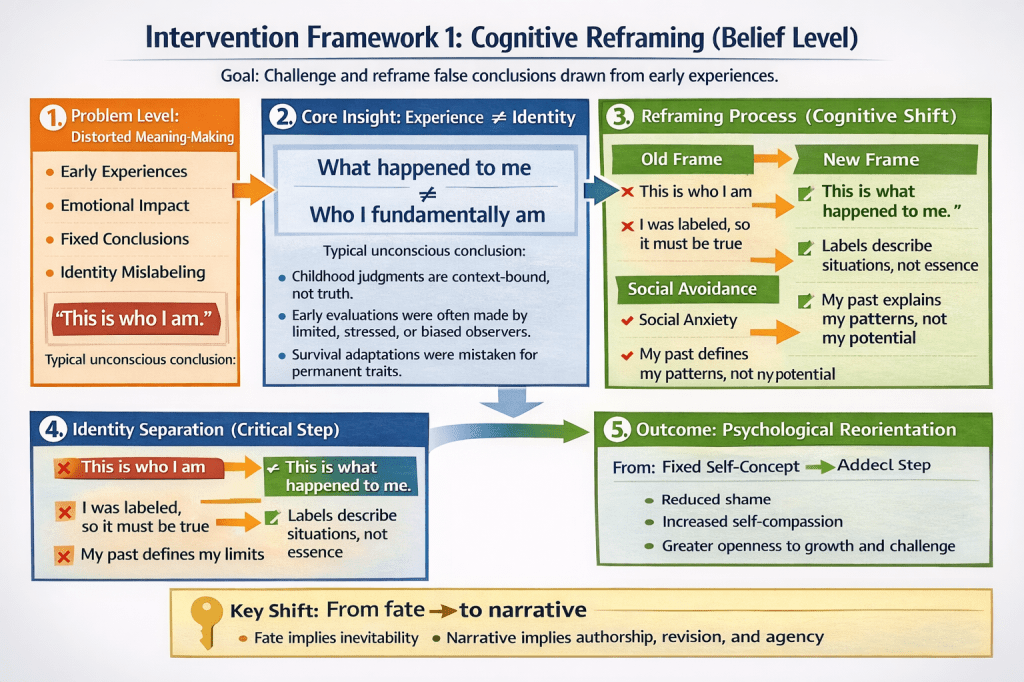
4.1 Cognitive reauthoring (CBT: beliefs into testable hypotheses)
The first step is to treat inferiority beliefs as thought-structures, not truths.
In CBT terms, this means identifying automatic thoughts, core beliefs, and habitual interpretations and testing them against evidence and alternative explanations.
The aim is not positive thinking, but reality-based reappraisal and cognitive flexibility.
Example shift:
From: “My background proves I don’t belong.” To: “I learned to feel I don’t belong; what evidence supports or contradicts this today?”
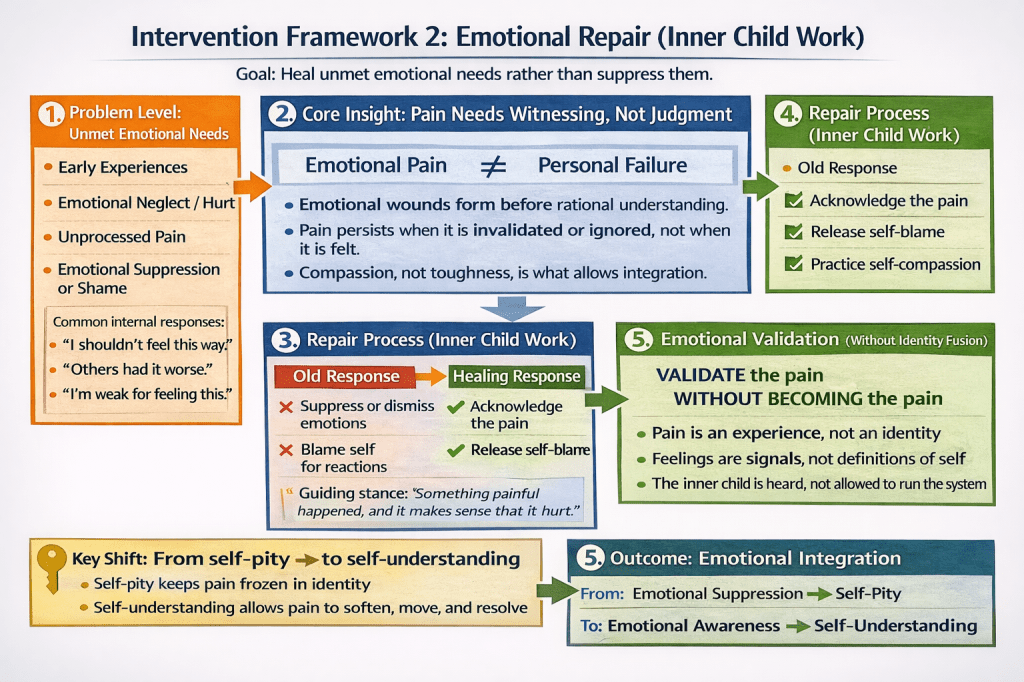
4.2 Emotional reauthoring (Adler + narrative: from self-pity to self-compassion)
Self-pity can function as psychological shelter: it explains pain without risking change. Adlerian work emphasizes movement toward social connection and courage, rather than remaining trapped in safeguarding behaviors. Narrative practice complements this by helping the person name the problem as separate from the self and build a story of resilience rather than defect.
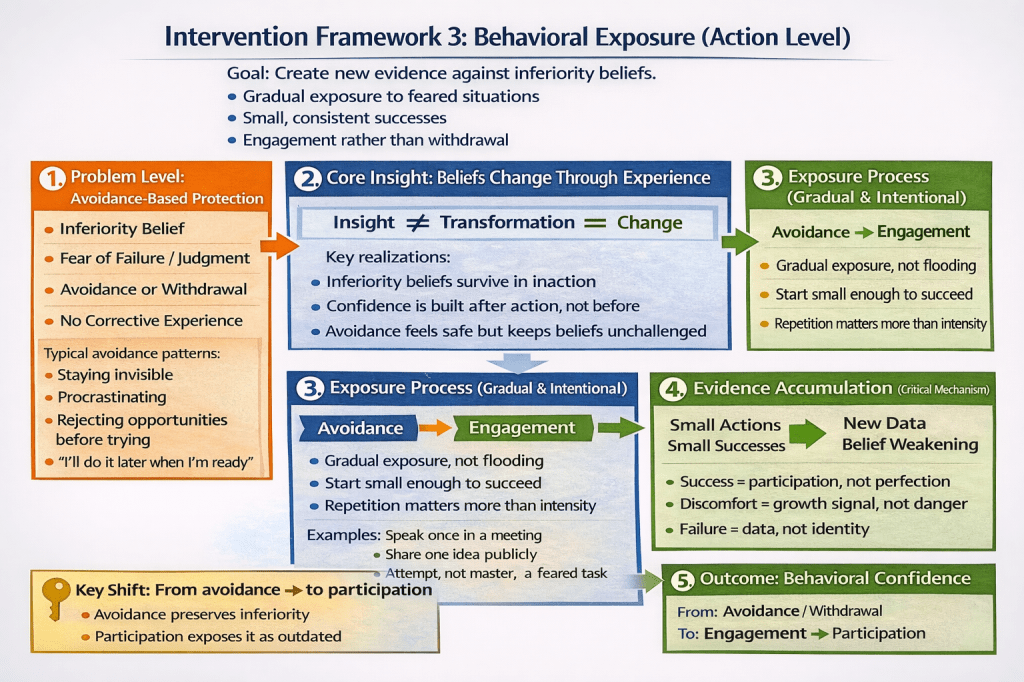
4.3 Behavioral reauthoring (new action creates new identity evidence)
Identity changes most reliably when behavior changes. Small exposures (social, academic, professional) produce lived evidence that contradicts inferiority.
This aligns with CBT’s behavioral emphasis: action is not the reward of confidence; often confidence is the result of action.
4.4 Relational reauthoring (from comparison to connection)
When inferiority dominates, other people’s happiness can feel like an accusation.
Reauthorising requires rebuilding one’s relation to others: shifting from comparison to connection, and from threat-based perception to shared humanity.
Adler’s stress on social feeling and community-oriented life goals is relevant here.

4.5 Existential reauthoring (Sartre: reclaiming freedom under the gaze)
Sartre’s analysis of being looked at highlights the temptation to live as an object in others’ eyes. Recovery involves reclaiming subjectivity: recognizing that others may look, judge, or misunderstand, yet the self remains responsible for how it chooses and lives.
This reframes self-consciousness: not as a life sentence, but as a human condition navigable through freedom and commitment.
5. Closing Reflection
Deep-seated inferiority can shape an entire life because it is not only emotional it is interpretive. It becomes a story the person repeats until it feels like fact.
But inferiority is also learned, socially reinforced, and cognitively maintained; therefore it can be revised.
Reauthoring the self integrates Adlerian insight (inferiority and life-style), CBT strategies (belief-testing and behavior change), existential responsibility (freedom under the gaze), and narrative therapy (restorying and authorship).
Together, these perspectives move the individual from a life organized around deficiency, comparison, and self-doubt toward one organized around agency, participation, and meaning. Reauthorising the self does not erase the past; it repositions it. In doing so, it transforms inferiority from a life-defining verdict into a revisable chapter within a broader human narrative of growth and possibility.
References
Adler, A. (1964). The Individual Psychology of Alfred Adler: A Systematic Presentation in Selections from His Writings (H. L. Ansbacher & R. R. Ansbacher, Eds.). Harper & Row.
Beck, A. T., Rush, A. J., Shaw, B. F., & Emery, G. (1979). Cognitive Therapy of Depression. Guilford Press.
Brown, N. (2024). Sartre and the modality of bad faith: The contingency debate. Kritike
White, M., & Epston, D. (1990). Narrative Means to Therapeutic Ends. W. W. Norton
“Narrative Means to Therapeutic Ends” (overview). Narrative Approaches
Secondary discussions on Sartre’s “Look” and shame in Being and Nothingness (e.g., scholarly analyses).

Leave a comment