
The Visionary Who Built India and Its Engineers
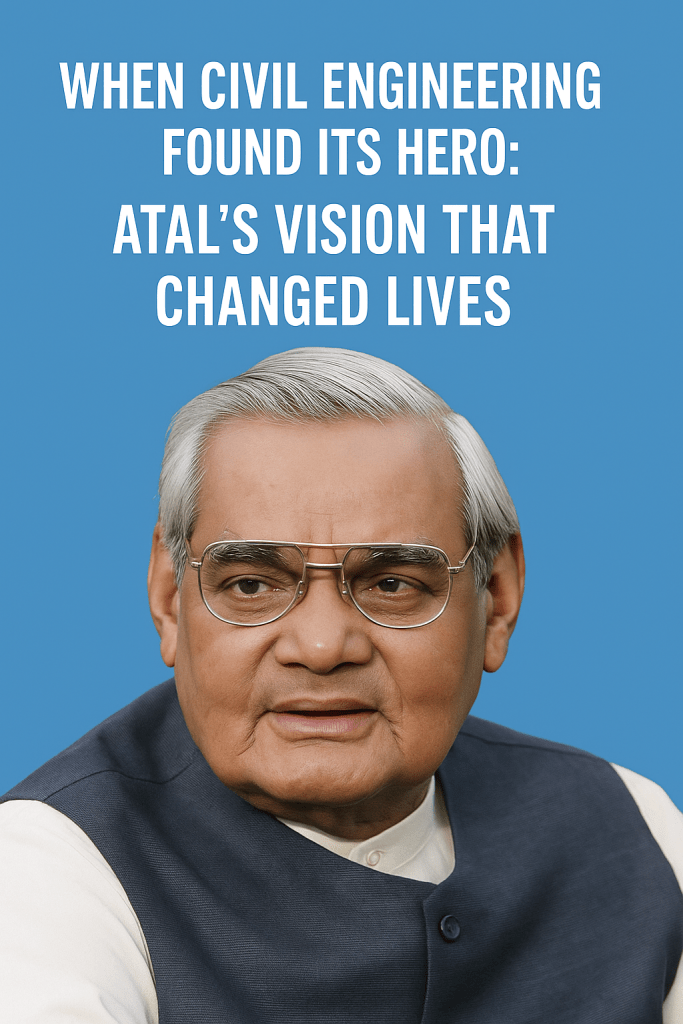
Before the era of large-scale national highways, express corridors, and modern infrastructure, civil engineering in India was a profession struggling for survival. In the late 1980s and early 1990s, the employment landscape for civil engineers was bleak. Job opportunities were scarce, private construction was unorganized, and public works moved slowly. Many engineers found themselves working in conditions no better than Skilled labourers. Socially too, the profession had lost respect—fathers hesitated to marry their daughters to civil engineers, and engineering graduates often switched careers to survive.
Amid this crisis emerged a leader whose vision would redefine not only India’s infrastructure but also the professional identity of civil engineers—Shri Atal Bihari Vajpayee.
A Profession in Distress: The Pre-Vajpayee Era
The early 1990s were a turbulent time for India’s engineers. Economic reforms had begun, but infrastructure spending remained minimal. Civil engineers faced:
• Unemployment rates much higher than other engineering branches
• Lack of structured private-sector opportunities
• Stagnant government recruitment
• Outdated construction technologies and slow project execution
In many states, engineering graduates stood in queues for months seeking contract labour-level work. The mismatch between skills and opportunities created widespread frustration. A highly skilled profession had been reduced to underemployment.
Vajpayee’s Leadership: A Turning Point in India’s Infrastructure Story
When Atal Bihari Vajpayee became Prime Minister, he recognized the crisis. During developer and engineering interactions, he famously remarked:
I may not be able to give every engineer a government job, but I can give work to every engineer.
This statement became the seed of one of the largest infrastructure revolutions in India’s history.
The Golden Quadrilateral: A Vision Beyond Roads
The Golden Quadrilateral (GQ) project, launched in 2001, was a landmark initiative to link Delhi, Mumbai, Chennai, and Kolkata with 5,846 km of world-class highways. It was more than a road project—it was a nation-building mission.
Key impacts:
• Introduced international construction standards
• Boosted employment for lakhs of civil engineers
• Modernized contracting processes
• Increased demand for surveyors, designers, project managers, structural engineers, and planners
• Attracted global construction firms to India
• Accelerated urbanization and industrial growth
For the first time, Indian civil engineers worked on projects matching global benchmarks.
The National Highways Development Project (NHDP)
The Golden Quadrilateral was followed by the North–South and East–West Corridors (7,142 km), creating a unified highway system unprecedented in India. These projects:
• Expanded the demand for technical expertise
• Shifted India from manual labour-intensive construction to mechanized engineering
• Increased investments in bridges, tunnels, flyovers, and interchanges
Civil engineering was no longer a profession in crisis—it became central to national development.
A New Era for Civil Engineers
The Vajpayee-era infrastructure push produced long-lasting transformation:
• Massive job creation across public and private sectors
• Rise of large Indian infrastructure companies
• Introduction of PPP (Public–Private Partnership) models
• Modernization of construction education and training
• Emergence of consultancy firms and design houses
• International opportunities for Indian engineers
Civil engineering regained its dignity, respect, and value in society.
Social Transformation: From ‘L Class’ to Nation Builders
The change was not only economic but also cultural. Families once hesitant to support civil engineering began celebrating it. The profession evolved from being undervalued to being seen as one of the pillars of India’s modernization.
Atal Bihari Vajpayee became widely regarded as the “Hero of Civil Engineers”—the leader who gave them identity, dignity, and opportunity.
Legacy
Today, India’s expressways, smart cities, metro networks, airports, and industrial corridors all trace their ideological roots to the Vajpayee era. His vision created a structural foundation on which future governments continue to build.
He did not merely build roads—he built opportunities. He built confidence. He built the careers of millions.
Closing Reflection
Civil engineering in India has many contributors, but its revival has one unmistakable hero—Shri Atal Bihari Vajpayee. His farsighted vision transformed infrastructure from a slow-moving sector into a dynamic engine of growth, creating a golden era for civil engineers.
The roads he built connected cities but the opportunities he created connected engineers to their future.

Leave a comment