
India’s Cult Politics: Faith, Power, and the Struggle for Democracy
Introduction
On a humid May evening in Varanasi, saffron flags ripple above the Ganga as thousands wait in choreographed anticipation. Loudspeakers blare chants not of party or policy, but of person: ‘Modi hai toh mumkin hai’—’If there is Modi, it is possible.’ The scene captures the essence of India’s cult politics, where leaders become more than politicians—they become redeemers.
This phenomenon is not unique to India. In international history, perhaps the most infamous example of cult politics gone wrong is Jim Jones, the American preacher who built the ‘People’s Temple.’ His charisma turned followers into unquestioning devotees, culminating in the 1978 Jonestown tragedy where more than 900 people died in a mass murder-suicide in Guyana. While India’s cult politics is grounded in democratic processes rather than totalitarian enclaves, the comparison serves as a cautionary reminder: when devotion replaces dissent, institutions risk collapse, and human costs can be catastrophic.
In India, cult politics operates within ballots and welfare rather than isolationist communes, yet the dynamics of charisma, faith, and blind loyalty echo across borders. Faith has often shaped social behaviour, identity and politics. Over decades, what might begin as spiritual leadership can morph or be transformed into forms of political clout, social influence and mobilization. The notion of cult politics refers less to fringe sects and more to the growing trend where charismatic spiritual figures become de-facto opinion makers sometimes supplanting or influencing formal political institutions.
The Broader Context: Religion and Politics in India
- Multiple academic and policy-oriented studies document how religious identity has long shaped political behaviour in India: voting patterns, party mobilization, communal alignments, and public policy.
- Historically, post-independence India attempted a model where religion and state were kept formally distinct but the reality has often been more fluid. The principle of “equal respect for all religions” rather than strict separation has meant religion remains deeply entwined with politics.
- In recent decades, scholars argue that a form of political Hinduism has been gaining structural strength not limited to one party, but increasingly influencing the national discourse on identity, citizenship, and the very idea of the Indian state.
Thus, the rise of charismatic spiritual figures claiming moral authority poses fundamental questions: Can a secular and pluralistic democracy withstand religious-populist mobilization? What happens when faith and political identity converge?
From Jim Jones to Indian leaders, the lesson remains—when politics becomes religion, citizenship can slip into discipleship.
In November 1978, Jim Jones, the leader of the People’s Temple, commanded over 900 of his followers to take their own lives in what became known as the Jonestown Massacre in Guyana. Under the pressure of his apocalyptic sermons and threats of violence, families lined up to drink a fruit-flavored beverage laced with cyanide and sedatives. Those who hesitated were coerced at gunpoint by Jones’s armed guards, and children were poisoned first to compel parents to comply.
Jones framed the act as a revolutionary protest, declaring it was ‘better to die than live under oppression.’ The chilling obedience—people drinking poison in unison while his voice blared over loudspeakers—remains the most extreme example of how charisma and fear can override reason and survival instinct itself.
For democracies like India, Jonestown is a cautionary tale: while cult politics here operates within elections rather than isolated communes, the emotional intensity of devotion carries inherent risks. When loyalty to a leader becomes absolute, the line between citizenship and discipleship can disappear—with catastrophic consequences.
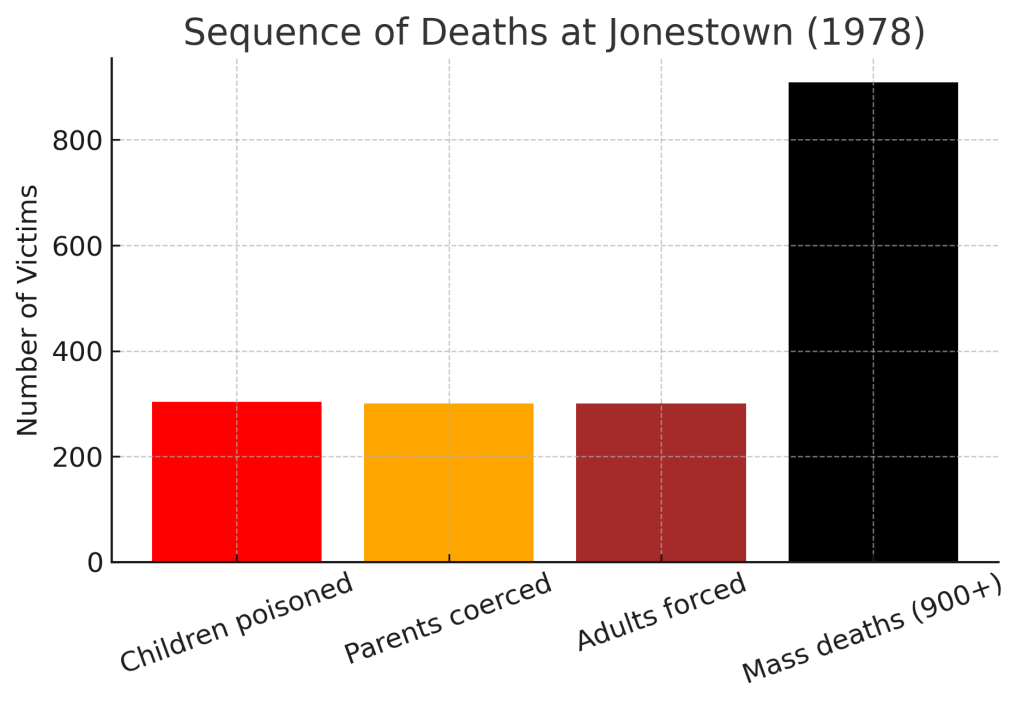
Jonestown Death Sequence
This infographic illustrates the tragic sequence of deaths at Jonestown in 1978. Children were poisoned first, followed by parents and other adults under coercion, leading to over 900 deaths in total.
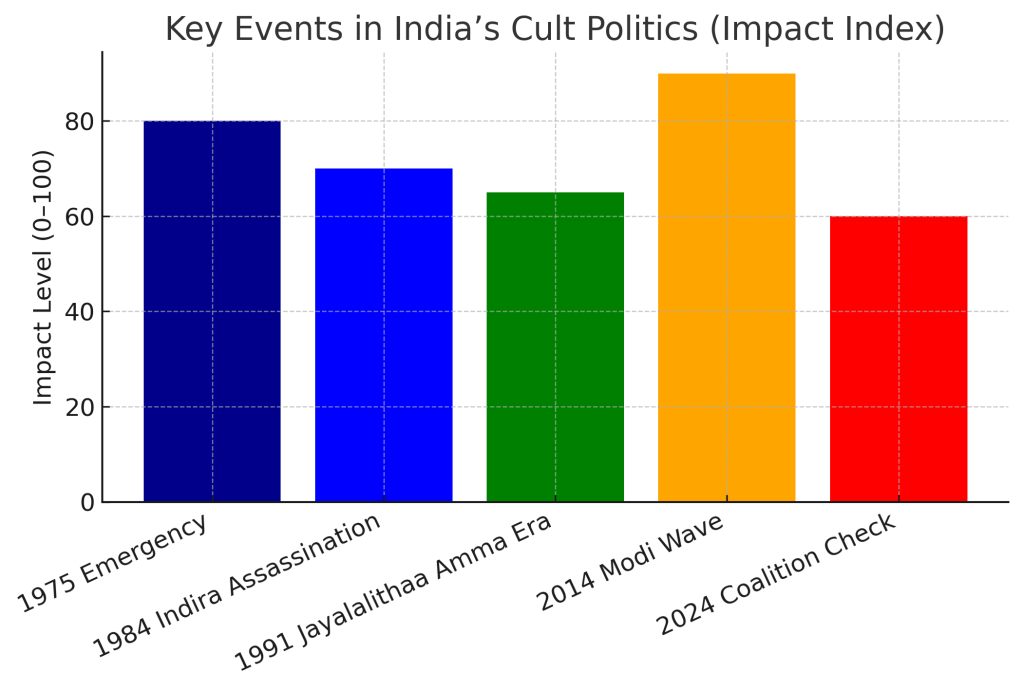
Key Events in India’s Cult Politics
This infographic highlights milestone events in India’s cult politics—from the 1975 Emergency under Indira Gandhi, to Jayalalithaa’s Amma welfare era, to Narendra Modi’s sweeping 2014 victory, and the coalition rebalancing of 2024. The ‘impact index’ illustrates their relative influence on India’s democratic trajectory.
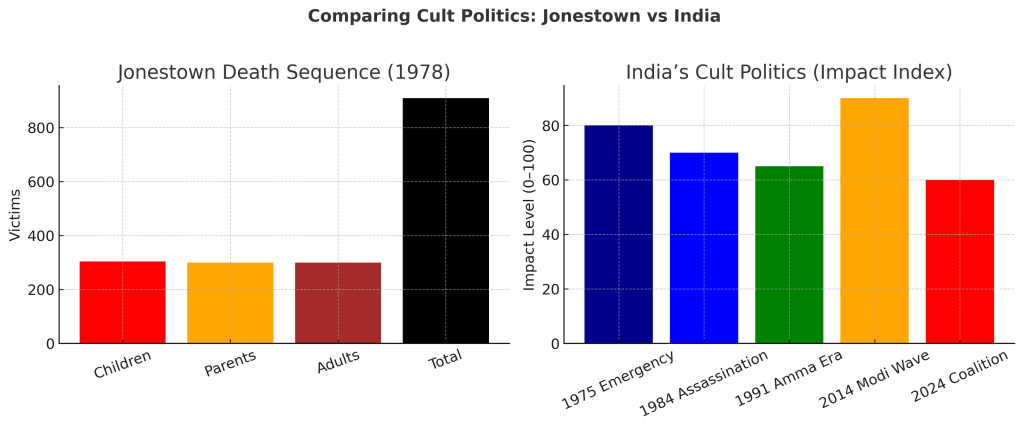
Comparative Infographic: Jonestown vs India’s Cult Politics
This side-by-side infographic contrasts the tragic Jonestown massacre of 1978 with milestone events in India’s cult politics. It illustrates how devotion to charismatic leaders can take radically different trajectories—from catastrophic collapse to democratic resilience.
Charisma and Populism: Theoretical Lens
Cult politics in India is deeply intertwined with Max Weber’s concept of charismatic authority and Jan-Werner Müller’s definition of populism. It fuses religious imagery, political spectacle, and welfare branding into an electoral machine where the leader is synonymous with the state.
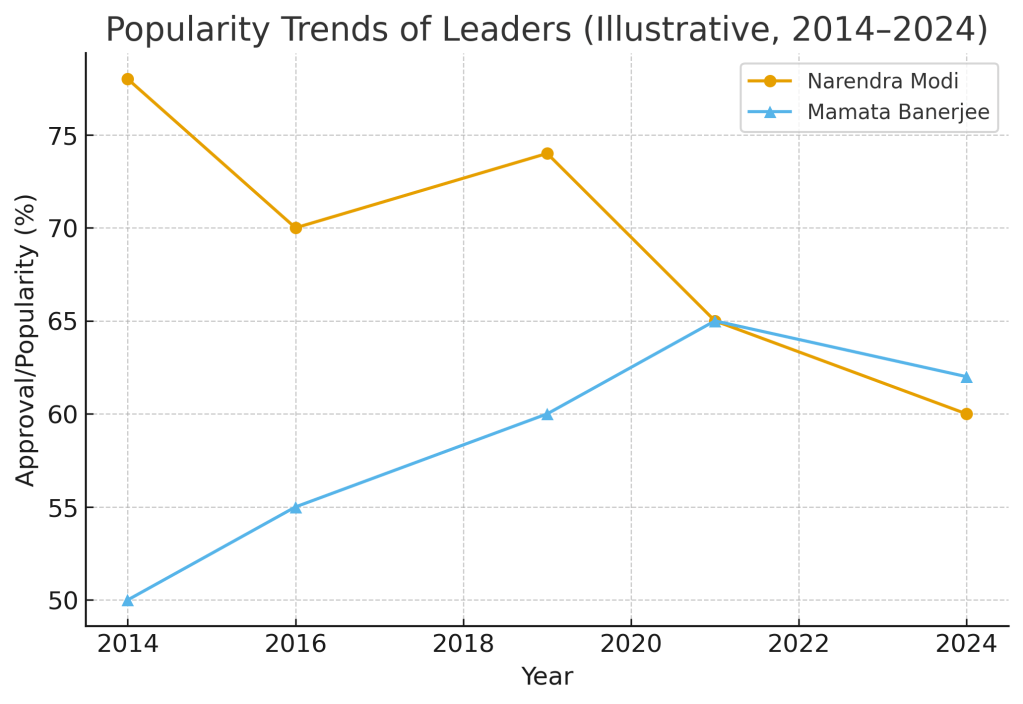
Leader Popularity Trends
The comparison of approval trends underscores both the resilience and fragility of cult politics in India. Popularity can be exceptionally high but is also subject to sharp declines depending on political events.
Indira Gandhi as the Durga Archetype
Indira Gandhi’s cult of leadership was one of the earliest and most enduring examples of charismatic politics in India. After her decisive role in the 1971 war against Pakistan, she was hailed as ‘Durga,’ the goddess-warrior. This myth-making transformed her from a political leader into a near-sacred figure. Posters carried her face haloed, slogans like ‘Indira is India’ were popularized, and policy decisions were directly associated with her persona.
The Emergency period (1975–1977) revealed the dangers of unchecked personalization of power. Civil liberties were suspended, the press was censored, and mass sterilization campaigns were carried out under her son Sanjay Gandhi’s direction. Yet the cult was reversible: voters decisively rejected her in 1977, proving India’s electorate retained democratic agency even in the shadow of a towering personality. Her assassination in 1984 restored her to martyrdom and sealed her place as an archetype of cult politics.
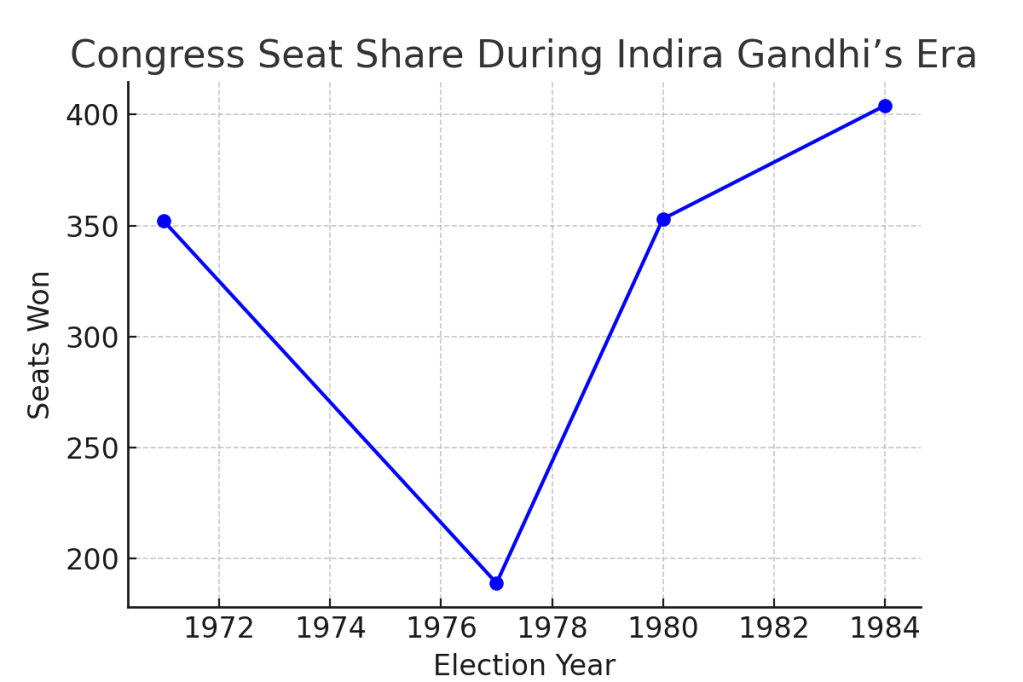
Indira Gandhi’s Era (1971–1984)
This graph shows the dramatic rise and fall of Indira Gandhi’s Congress dominance: a peak in 1971 after the Bangladesh war, a sharp fall in 1977 after the Emergency, and a return to power in 1980 followed by her martyrdom after 1984.
Jayalalithaa and the Southern Laboratory
In Tamil Nadu, Jayalalithaa Jayaram, fondly called ‘Amma’ (Mother), built one of the most sophisticated cults in democratic politics. Her welfare schemes—from ‘Amma Canteens’ serving low-cost meals to ‘Amma Water,’ ‘Amma Cement,’ and even ‘Amma Pharmacies’—transformed her persona into a living brand. Citizens interacted with the state through ‘Amma,’ personalizing governance as an act of maternal care.
Her cult was reinforced by cinema, where she began as an actress, and by ritualistic displays of devotion: supporters carried her portraits, prostrated before her motorcade, and even engaged in acts of self-harm at her legal troubles. Unlike Indira’s cult, Amma’s charisma was deeply embedded in welfare delivery, ensuring her presence in everyday life even after her death in 2016.
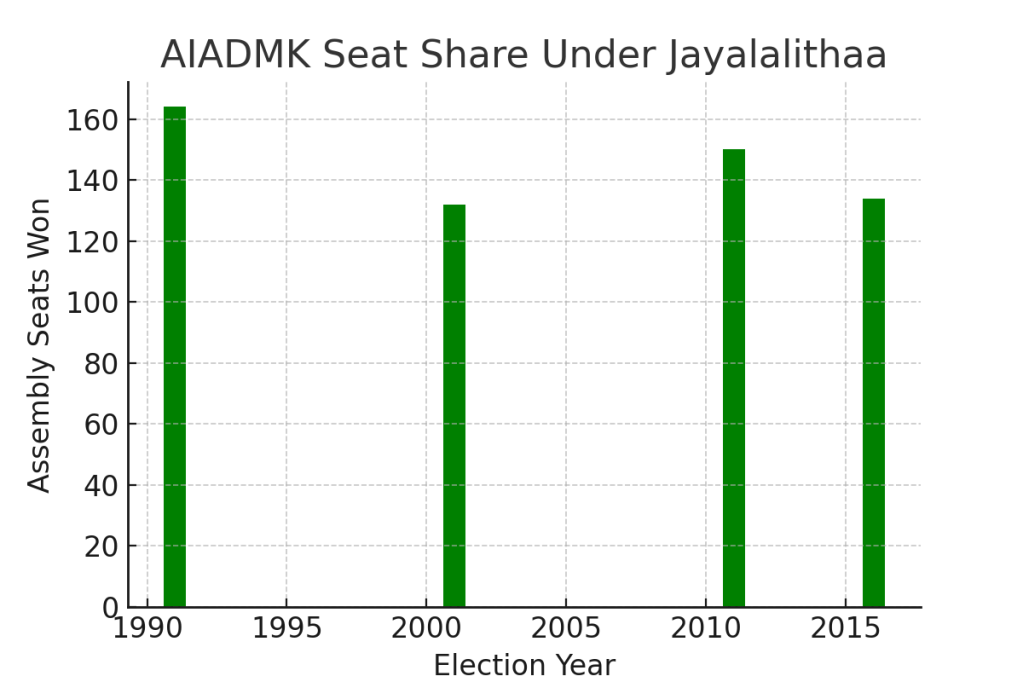
Jayalalithaa’s Era (1991–2016)
Jayalalithaa’s AIADMK repeatedly returned to power, fueled by her welfare schemes. Her leadership transformed Tamil Nadu’s politics, with her personal brand (‘Amma’) integrated into governance through subsidized canteens, cement, and pharmacies.
The Modi Era: Personalization at Scale
Narendra Modi represents the most globally visible manifestation of cult politics in India. Rising from humble beginnings, his image as a self-made, incorruptible leader has been central to his political narrative. His tenure since 2014 has been marked by the personalization of virtually every government scheme—from ‘Pradhan Mantri Jan Dhan Yojana’ to ‘Swachh Bharat Abhiyan’—marketed as gifts from Modi to the people.
His radio program ‘Mann ki Baat,’ holographic campaign rallies, and digital outreach have magnified his presence into a near-omnipresent figure. The integration of Hindu nationalist symbolism with governance—temple inaugurations, religious festivals framed as state events—further blurred lines between faith and politics. By 2024, his name was synonymous with the BJP itself, the election framed as a plebiscite on Modi rather than on policies or candidates.
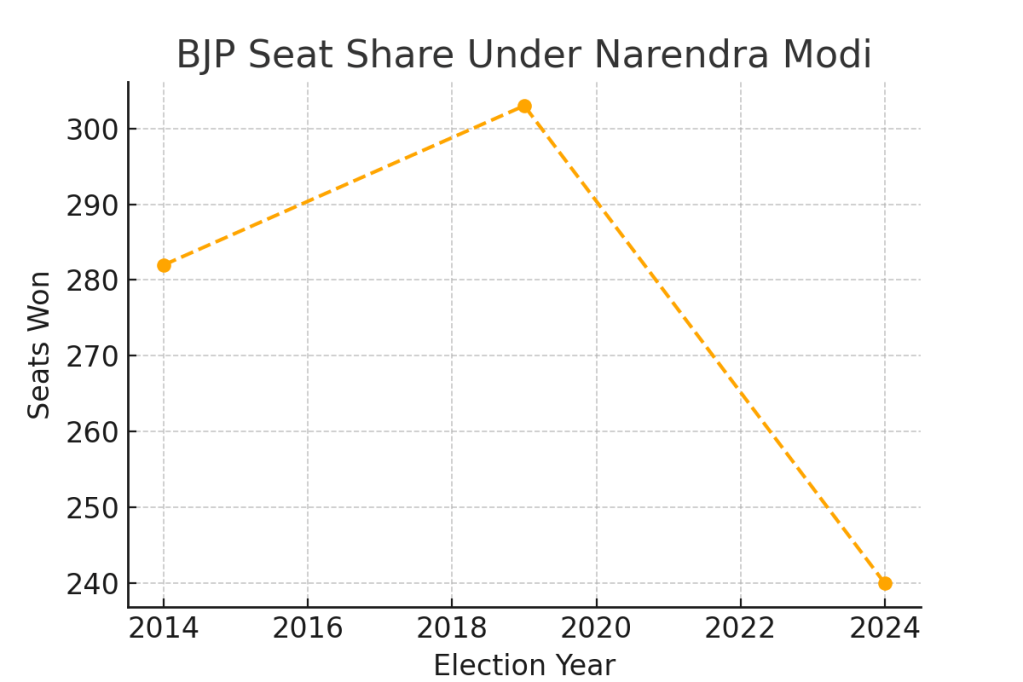
Era (2014–2024)
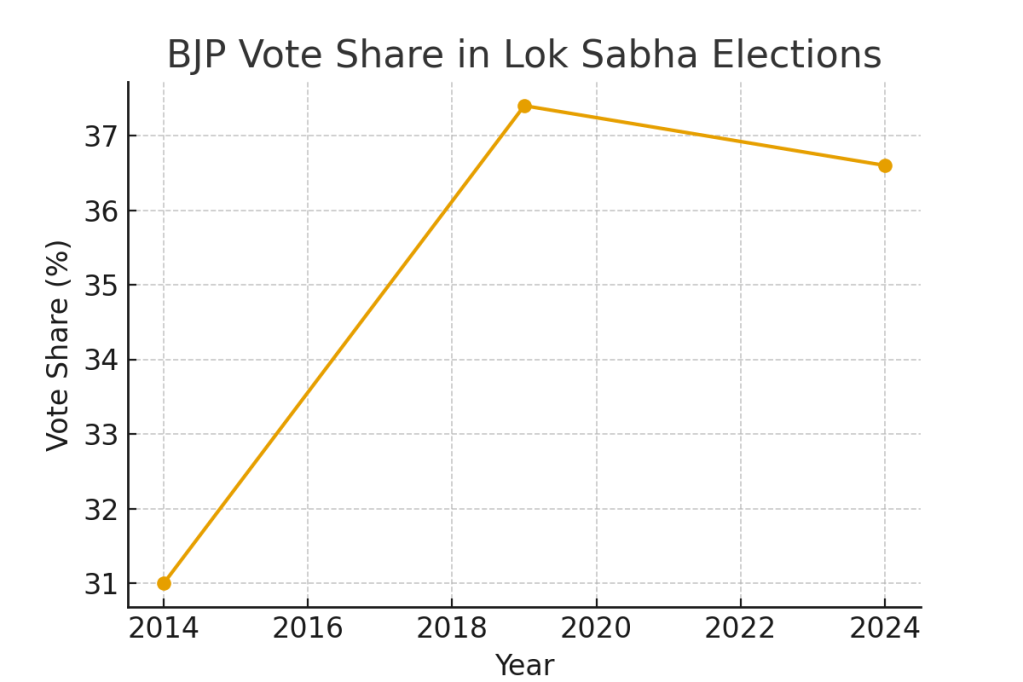
Narendra Modi’s BJP surged to historic victories in 2014 and 2019, establishing him as the dominant figure in Indian politics. The dip in 2024 highlights the limits of personalized politics as coalition dynamics reasserted themselves.
BJP Vote Share (2014–2024)
The chart below illustrates how BJP’s vote share has fluctuated while remaining leader-centric.
Political Influence of Godmen
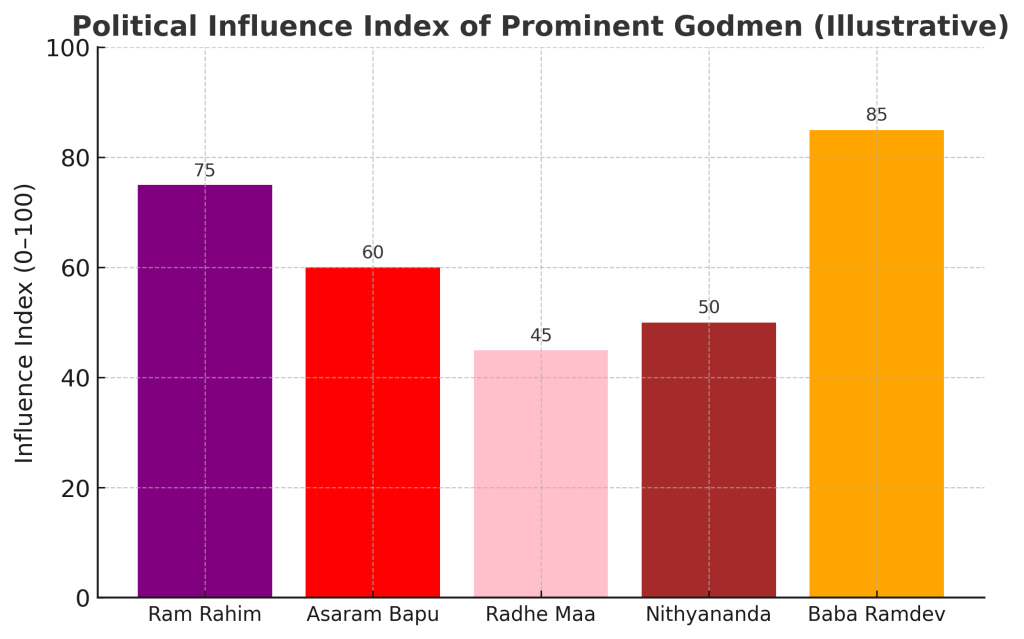
This illustrative graph highlights the relative political influence of major godmen in India. Figures like Baba Ramdev and Gurmeet Ram Rahim Singh show high levels of political connectivity, while others such as Radhe Maa and Nithyananda represent localized but notable cult phenomena.
Case Studies: Cult Politics and Godmen
1. Gurmeet Ram Rahim Singh (Dera Sacha Sauda): Known for his massive follower base in Haryana and Punjab, his influence was so pronounced that political parties often sought his endorsement during elections. In 2017, his conviction for rape led to violent riots, underscoring the risks of fusing religious cults with politics. His periodic paroles around election seasons highlight how political timing intersects with his influence.
2. Asaram Bapu : Before his conviction, Asaram’s sprawling network of ashrams doubled as political stages. Many politicians attended his gatherings, using his presence to tap into his devoted base. His fall from grace illustrates the volatility of charisma once legal and moral questions surface.
3. Baba Ramdev : Perhaps the most modern and politically savvy godman, Ramdev’s open support for Narendra Modi and the BJP in 2014 was a turning point. His yoga camps were repurposed into political mobilization arenas, while his Patanjali empire symbolized self-reliance aligned with nationalist politics. He demonstrates how spiritual charisma can transition into economic and political capital.
4. Radhe Maa : While not as politically entrenched as others, Radhe Maa’s dramatic persona and her following became useful for politicians looking to appeal to urban and suburban constituencies. Her case reflects the micro-level intersections of cult figures and electoral mobilization.
5. Nithyananda : Despite fleeing India amid allegations, Nithyananda’s ability to retain a loyal international following (even declaring a self-styled nation, ‘Kailasa’) highlights the transnational nature of cult charisma. Though his direct electoral impact was limited, his case shows how cults can thrive beyond borders while still influencing regional discourse.
Dhirendra Shastri: Spiritual Leader, Public Figure, Political Symbol
Bringing the general phenomenon to ground, Dhirendra Krishna Shastri illustrates many features central to cult politics:
- He has openly opposed what he defines as “extremism” and violence, stating that real spirituality is about cultural pride and not aggression.
- At the same time, his public interventions have caused controversy: for example, he reportedly called for a constitutional amendment to declare India as a “Hindu Rashtra” — a demand that sparked criticism from political commentators such as Prashant Kishor, who argued that a democracy cannot be run based on the diktats of religious babas.
- These episodes highlight a critical tension: while many followers regard him as a spiritual guide, such figures can also emerge as political influencers shaping narratives about national identity, citizenship, and public morality outside the formal democratic process.
Moreover, his prominence reveals the shifting boundaries between religion and politics: what once may have been personal faith now strongly intersects with collective identity, political ideology, and social mobilization.
Critical Questions: What Should India’s Democracy Do?
This forces us to ask:
- How to safeguard secularism without curbing religious freedom? India’s constitutional framework allows freedom of religion but when religion turns political, how should the state respond to ensure equality and justice?
- What role should spiritual leadership have in a democracy? Is there space for moral/spiritual guidance separate from formal politics or does any public religious leader’s influence inevitably offset democratic balance?
- How to ensure institutions remain central over individuals? Can democratic culture promote ideals over personalities? How to prevent reliance on charisma rather than policy and institutional mechanisms?
- Can society resist identity-based polarization? In a society as diverse as India’s, how do we preserve pluralism, protect minority rights, and discourage majoritarian religious nationalism?
- What reforms or civic measures are needed? Education, media literacy, institutional transparency and inclusive political dialogue are these enough to counter the rise of “cult politics”?
2024 Elections: Cult Meets Coalition
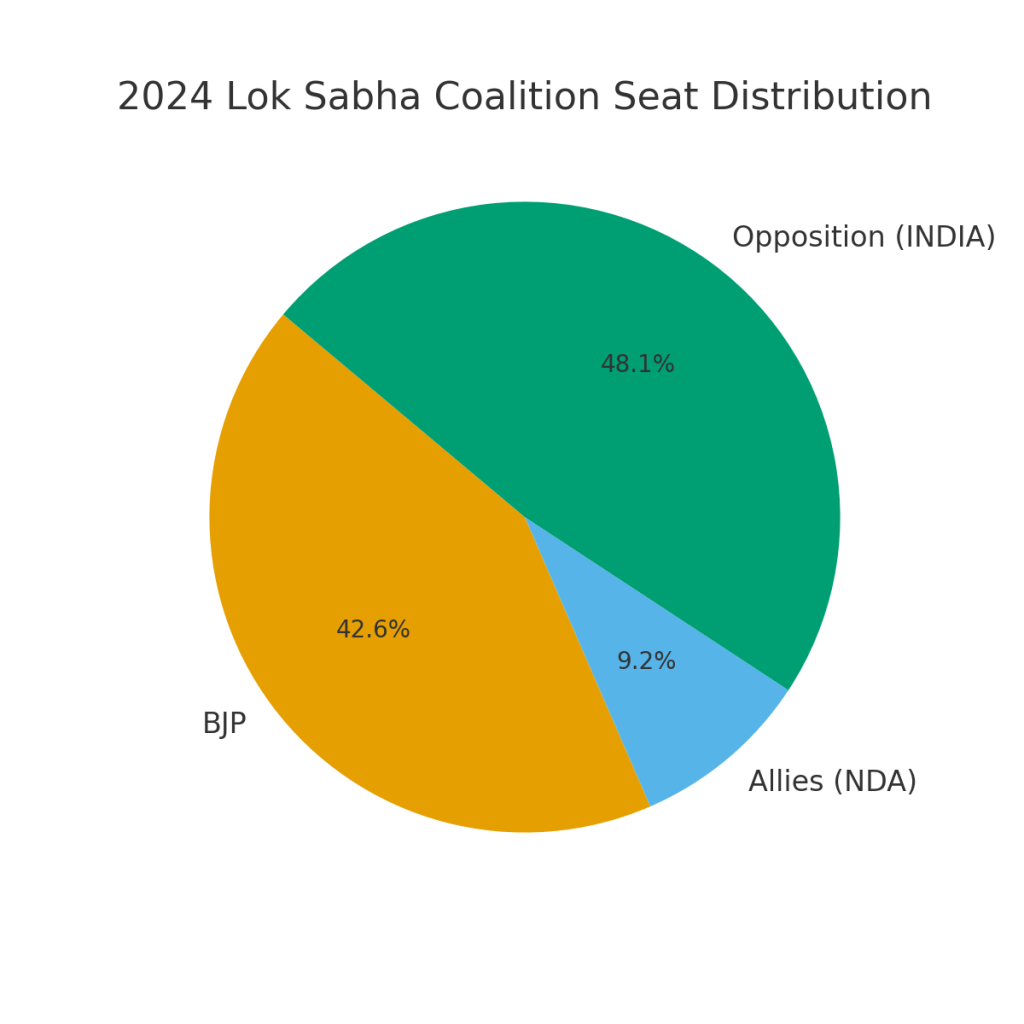
The 2024 Lok Sabha elections offered a striking stress test for cult politics. The BJP secured 240 seats, falling short of a single-party majority for the first time since 2014. While Modi’s charisma remained central to the campaign, coalition arithmetic reasserted itself, forcing the BJP to depend on allies within the NDA.
This result demonstrated both the strength and limits of cult politics. Modi’s brand continued to mobilize millions, yet the electorate signaled a demand for institutional balance and accountability. It underscored the resilience of India’s democratic architecture: federalism, coalition politics, and voter agency acted as correctives against total personalization of power.
Coalition Politics 2024
The 2024 results highlight the limits of single-leader dominance. While the BJP remained the largest party, coalition partners and opposition together accounted for a larger share, reasserting India’s pluralism.
Regional Counter-Cults
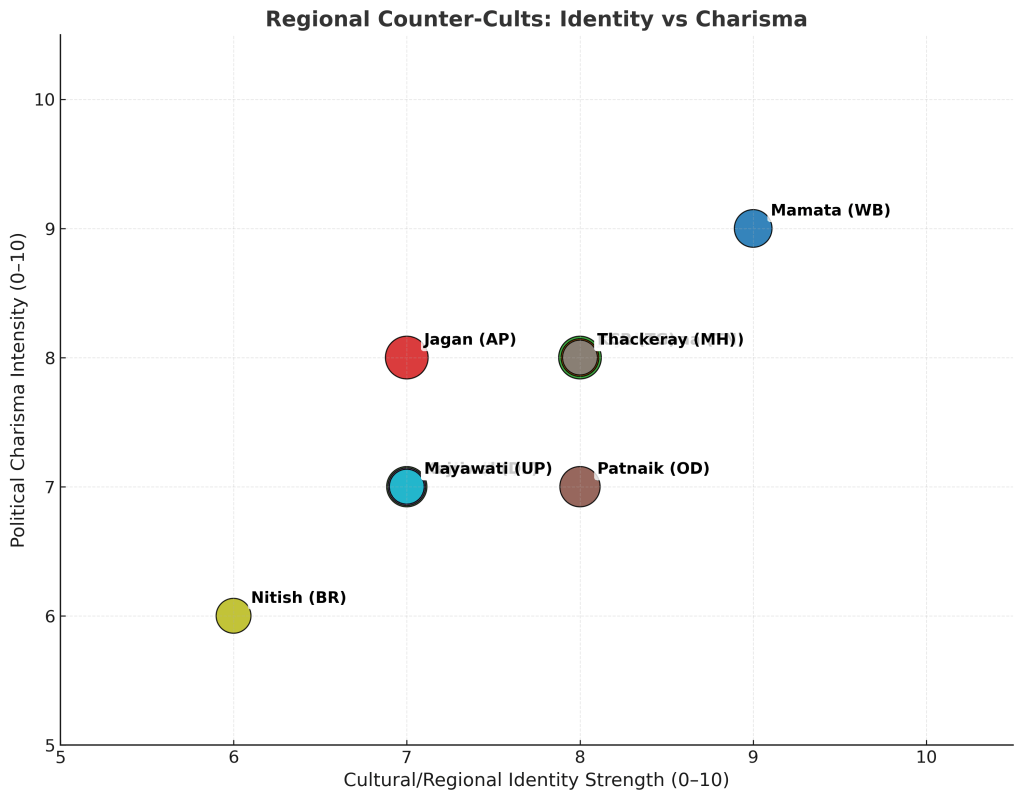
India’s federal system has nurtured counter-cults at the state level.
Mamata Banerjee in West Bengal, projecting herself as ‘Didi’ (elder sister), mobilized Bengali pride and welfare populism to resist the BJP’s advance. Her charisma is entwined with regional identity, offering a cultural counterweight to Modi’s Hindu-nationalist appeal.
In Tamil Nadu, the legacy of Amma persists even after Jayalalithaa’s death, with successors invoking her memory to claim legitimacy. These regional cults highlight that Indian democracy is a marketplace of competing charismas, preventing the monopoly of any single leader at the national level
Naveen Patnaik in Odisha cultivates a soft charisma tied to clean governance and Odia identity, shielding his state from national waves, while
Arvind Kejriwal in Delhi channels an “Aam Aadmi” anti-elite persona, his cult-lite resting on schools, mohalla clinics, and anti-corruption narratives.
In Andhra Pradesh, Y.S. Jagan Mohan Reddy forges direct reciprocity through cash-transfer governance (Navaratnalu), exemplifying welfare-personalization loops, and in Telangana, K. Chandrashekar Rao fuses statehood-movement charisma with programs like Rythu Bandhu, wielding strong regional identity as a shield against central parties.
Elsewhere, Mayawati in Uttar Pradesh remains a Dalit dignity icon, using parks and statues as durable symbol politics that derive authority from social justice, while Bal and Uddhav Thackeray in Maharashtra carry forward Shiv Sena’s Marathi asmita and street spectacle, with Uddhav’s softer image showing how hard cults adapt.
Finally, Nitish Kumar in Bihar projects a low-drama persona, but his “Sushasan” governance and prohibition policies have cultivated a distinctive followership, one defined less by spectacle than by administrative credibility.
These regional cults highlight that Indian democracy is a marketplace of competing charismas, preventing the monopoly of any single leader at the national level
Regional Counter-Cult : Identity vs Charisma
The New Machinery of Cult Politics
Three engines drive modern cult politics: media saturation, campaign centralization, and welfare branding. Television, cinema, and social media magnify leaders into mythic figures, their speeches and gestures endlessly replayed. Campaign finance is centralized, making leaders the focal point of all party communication. Welfare schemes are branded in personal terms—food rations, toilets, gas cylinders—all presented as the leader’s benevolence.
This machinery is unprecedented in scale and efficiency, ensuring leaders dominate the public imagination while bureaucracies fade into the background.
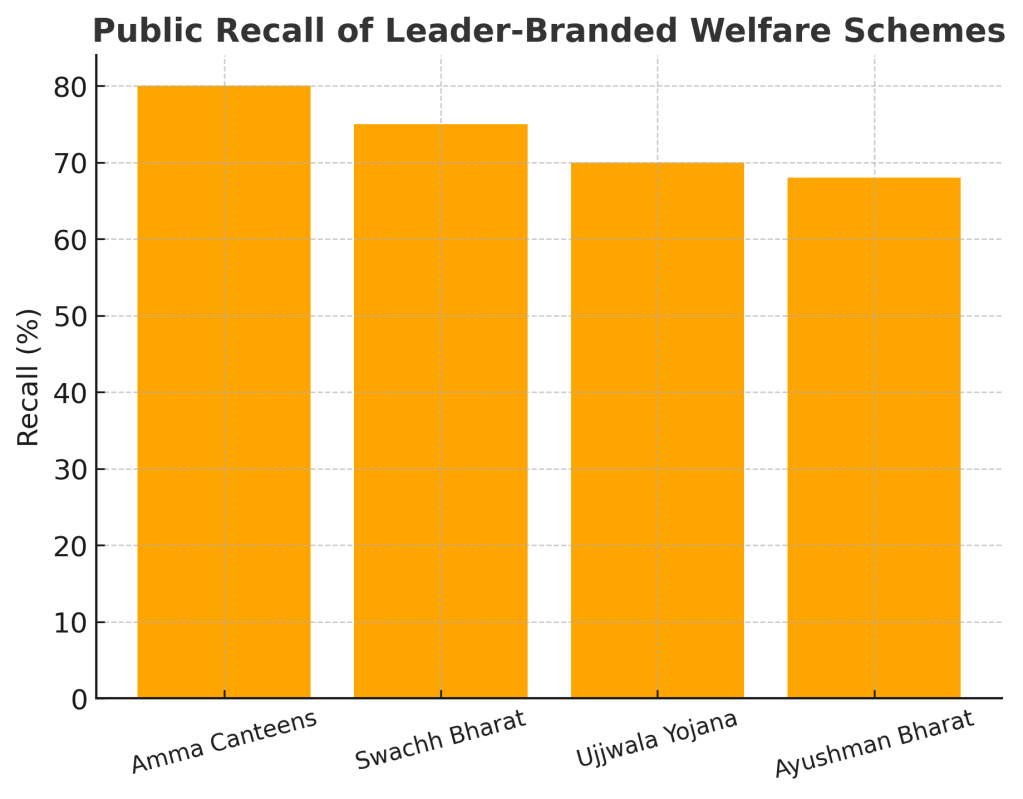
Welfare Scheme Branding
This chart demonstrates how welfare schemes branded with leader identities—such as Amma Canteens or Modi’s Swachh Bharat—achieve high recall among the public, illustrating the personalization of welfare delivery.
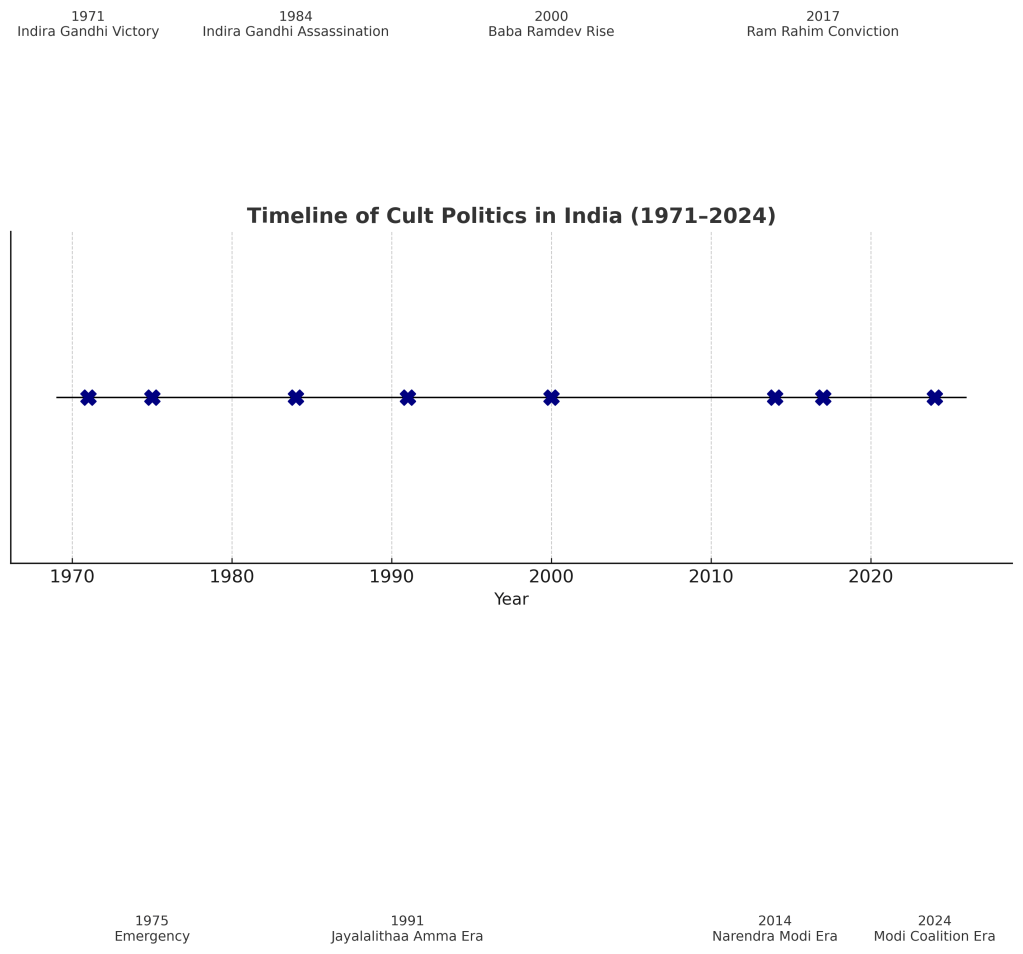
Timeline of Cult Politics in India’s Cult Politics: Faith, Power, and the Struggle for Democracy
This timeline traces the evolution of cult politics in India, from Indira Gandhi’s charismatic dominance, through Jayalalithaa’s welfare cult, to Modi’s era of personalization, alongside the influential role of godmen.
Risks to Democracy
Cult politics narrows the democratic public sphere. By portraying opponents as anti-national or corrupt, it delegitimizes dissent and weakens pluralism. Institutions—from courts to the press—risk capture by the leader’s narrative, eroding checks and balances. Policy debates become loyalty tests, reducing complex governance issues to matters of personal faith in the leader.
Globally, similar patterns have been observed in Turkey under Erdoğan and in the United States under Trump, but India’s scale and diversity make the risks particularly significant. A democracy of 1.4 billion cannot afford the centralization of legitimacy in a single figure.
Correctives and Futures
Yet Indian democracy has proven resilient. The 1977 rejection of Indira Gandhi, the continued influence of regional leaders, and the coalition constraints of 2024 all demonstrate that cult politics, though powerful, is not omnipotent. Voters have repeatedly demanded performance beyond personality, rewarding leaders who deliver tangible welfare benefits.
Federalism acts as a guardrail, ensuring regional parties can assert their charisma. Coalition politics ensures power-sharing, even when one leader dominates the campaign narrative. Most importantly, the electorate’s capacity to reverse its earlier enchantments serves as the ultimate corrective.
Reflection Summary : After the Crest
India stands today at a pivotal juncture. On one hand lies the promise of a pluralistic, vibrant democracy — founded on constitutional values, diversity and rational debate. On the other lies a rising tide of religio-political mobilization — where spiritual charisma, faith-based identity, and populist appeals threaten to reshape public life, potentially at the cost of secular and democratic ideals.
These Religious Figures are emblematic of this tension. Whether their influence leads to social cohesion, collective identity, and moral revival or fractures institutions, erodes pluralism, and undermines democratic accountability — depends on how society, polity, and citizens respond.
In that sense, cult politics is not just about one guru or one temple it’s about the very future of India’s democracy.
Leader centric politics in India will not disappear; it will adapt. Charisma will find new vessels—regional identity, welfare engineered for direct reciprocity, celebrity-influencer politics, even techno-nationalist projects built on digital public goods and AI. What persists is the fusion of faith and politics, where leaders are cast as moral saviours across pulpits, television, and social media. The 2024 verdict—requiring allies to govern shows that democratic circuitry still works: federalism, coalitions, and public contestation act as fuses that prevent overload. The task is not to wish charisma away, but to channel it safely.
Public Takeaways
Separate service from spectacle. Support strong welfare, not leader-branded welfare. Demand neutral program names and clear taxpayer-funding disclosure on assets and cards.
- Watch for early “cult signals.” Leader = nation slogans; benefits framed as personal gifts; opponents cast as heretics; hollowed-out parties; ritualized loyalty displays.
- Keep faith private, scrutiny public. Back norms that limit clerical canvassing during polling periods and require transparent reporting of religious or corporate endorsements.
- Demand clean data politics. Public ad libraries, labels for AI-generated content, rapid deepfake takedowns, and voluntary “data-diet” settings during election months.
- Re-center policy questions. Who pays and how? What outcome in one year? What failsafe if the leader exits tomorrow?
- Strengthen local pluralism. Support regional media, attend ward-level forums, and reward candidates who can explain state subjects without national theatrics.
- Reward institutional courage. Prefer parties that hold internal elections, avoid naming schemes after living leaders, and publish spending and surrogate budgets.
- Practice civic hygiene online. Check date, source, and a second credible source before sharing.
Institutional Priorities
- Neutral-naming rule for public assets and schemes while a leader is in office; sunset clauses for personality branding.
- Disclosure walls: real-time reporting of ad spend, influencer contracts, and religious endorsements.
- AI/deepfake guardrails: watermarking, time-bound takedowns in campaign periods, and ECI-linked fact-check pipelines.
- Media independence: transparent government ad allocations and legal-defense support for public-interest journalism.
- Civic curriculum: election-season modules on propaganda, survey literacy, and basic digital forensics in schools and colleges.
- Party democracy: incentives or public funding tied to internal elections and audited membership rolls.
- Coalition transparency: pre-poll alliance contracts that publish minimum programs and red lines.
Why it matters
Cults simplify complexity and offer belonging—especially in anxious times. But the bill arrives later: policy whiplash, institutional capture, scapegoating, and a public sphere where disagreement feels sinful, not civic. India’s democratic genius is to absorb charisma without surrendering plurality. Each time the crest rises, federalism, courts, media, civil society, and voters—so far—have kept the republic from breaking.
References & Sources
Election Commission of India — General Election to Lok Sabha 2024 – Results. https://results.eci.gov.in/PcResultGenJune2024/index.htm
Election Commission of India — Past General Election Results (2014, 2019). https://eci.gov.in/results/
Government of India — Swachh Bharat Mission (Gramin). https://swachhbharatmission.ddws.gov.in/
National Health Authority — Ayushman Bharat PM-JAY. https://nha.gov.in/PM-JAY
Government of India — Pradhan Mantri Ujjwala Yojana (PMUY). https://www.india.gov.in/spotlight/pradhan-mantri-ujjwala-yojana
Down To Earth — How Tamil Nadu’s ‘Amma canteen’ scheme stood the test of time. https://www.downtoearth.org.in/governance/how-tamil-nadu-s-amma-canteen-scheme-stood-the-test-of-time-77776
Britannica — Charismatic Authority (Max Weber). https://www.britannica.com/topic/charismatic-authority
Jan‑Werner Müller — What Is Populism? (Princeton/UPenn pages). https://www.pennpress.org/9780812248982/what-is-populism/
2017 Northern India Riots — Gurmeet Ram Rahim Singh conviction (overview). https://en.wikipedia.org/wiki/2017_Northern_India_riots
Britannica — Jonestown. https://www.britannica.com/event/Jonestown
Wikipedia — Jonestown (overview, >900 deaths). https://en.wikipedia.org/wiki/Jonestown
Morning Consult — Global Leader Approval Tracker. https://morningconsult.com/form/global-leader-approval%20/

Leave a comment