
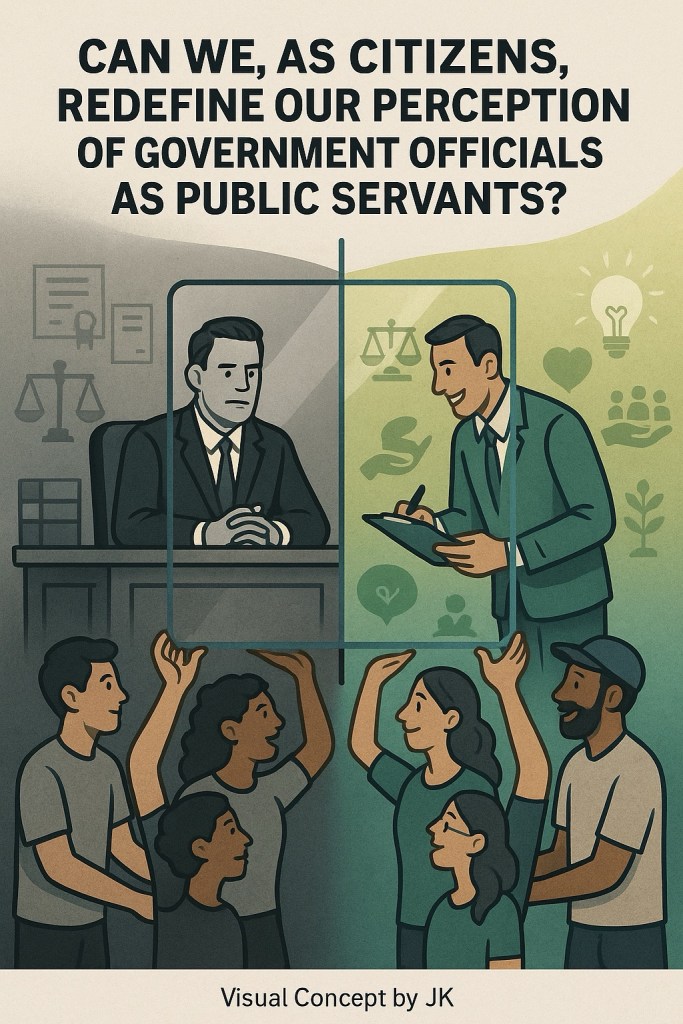
Redefine Your Perception of Government Officials as Public Servants?
In a democracy, the relationship between the government and the people is foundational. The Preamble to the Constitution of Indiabegins with the words “We, the People of India’, affirming that sovereignty rests not with the rulers but with the citizens. Government officials—whether administrators, police, of bureaucrats—are, by definition, public servants. Their role is to serve, facilitate, and empower the people, not to intimidate or rule-over them.
Yet, in practice, many citizens perceive officials as figures of authority to be feared rather than partners in governance. This distorted perception has grown over time due to hierarchical systems, colonial legacies, and instances of misuse of power. The pressing question is, can we, as citizens, change this perception and reclaim the constitutional vision of officials as true servants?
The Constitutional Perspective
The Indian Constitution envisions a government of the people, by the people, and for the people. Articles such as Article 311 (protection for civil servants), Fundamental Rights, and Directive Principles of State Policy together create a framework where public officials are meant to function within a system of accountability and service. The Preamble itself emphasizes justice, liberty, equality, and fraternity. This clearly rejects the idea of officials being rulers. Instead, it mandates them to uphold the dignity of citizens and to work.
Colonial Legacy and Present Reality
Much of the fear and awe surrounding government officers stems from India’s colonial administrative legacy. The British bureaucracy was designed to control, not to serve. After independence, while the system was retained for governance efficiency, the mindset of authority and superiority unfortunately persisted.
Towards a People-Centric Democracy
India’s democracy thrives when the citizen–officials need to reorient their roles. What Citizens Can Do:
1. Awareness of Rights: Citizens must know their constitutional rights and assert them respectfully.
2. Active Participation: Engaging in civic forums, filing RTIs, and holding officials accountable.
3. Rejecting Fear: Approaching officers with confidence as equal stakeholders in governance.
In my view, we as the public can—and must—change our perception. By remembering that sovereignty lies with the people, we reclaim our role as the supreme authority in a democracy.

Leave a comment