

India’s Infrastructure Through a Global Lens: A Monument of Corruption
by JK
India, the world’s fastest-growing major economy, has long positioned infrastructure as the backbone of its rise to global power. Expressways, smart cities, and industrial corridors promise transformation. Yet, while cranes and bulldozers signal ambition, the reality is far more sobering: chronic delays, inflated costs, and corruption. For global investors, India’s infrastructure often appears less like a pathway to opportunity and more like a monument to graft.
India in the Global Corruption Landscape

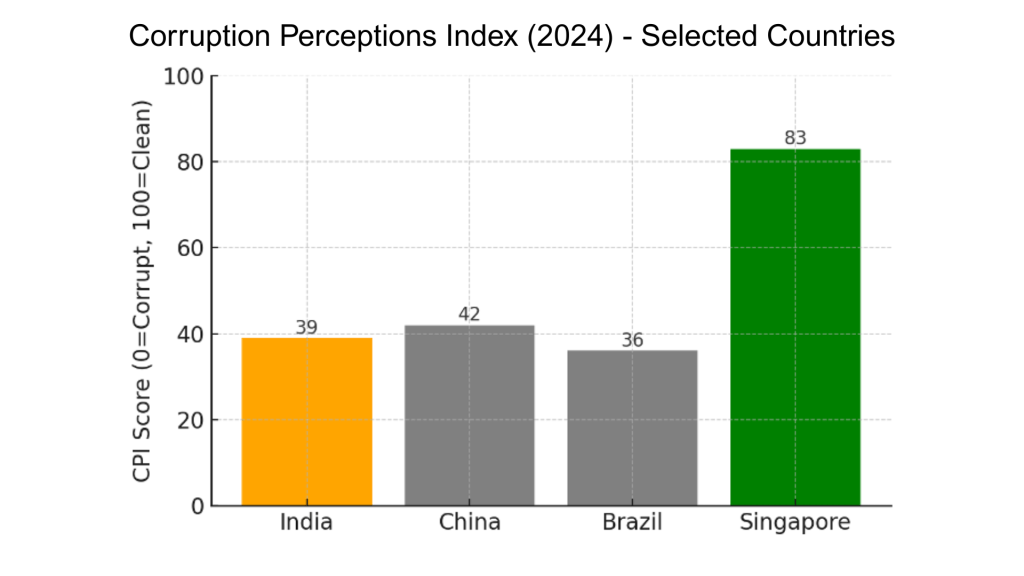
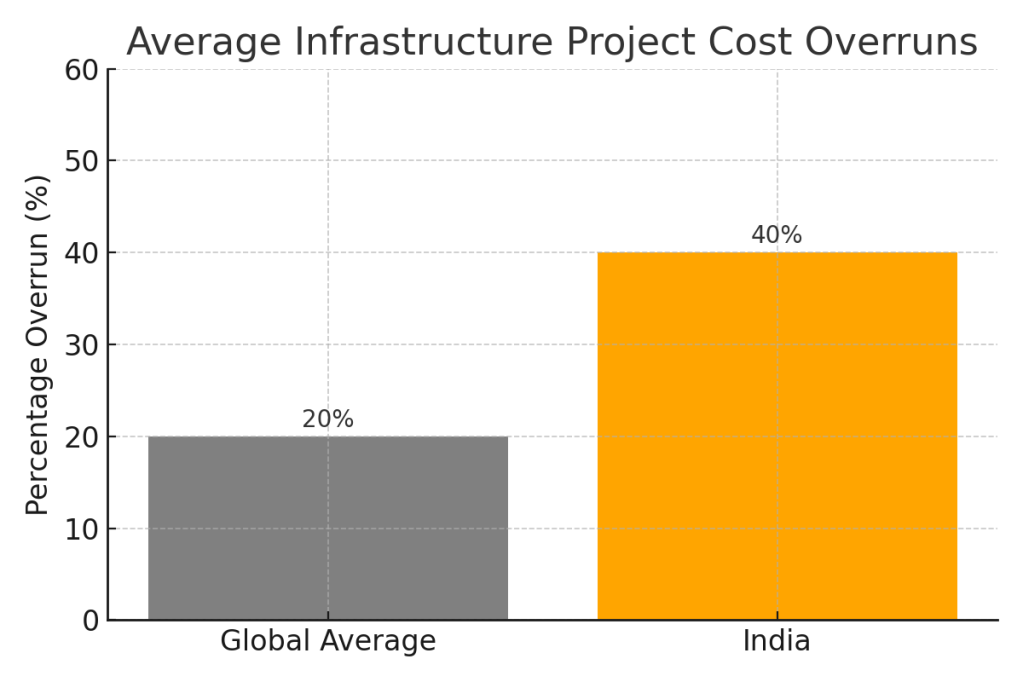
Figure 2: Average Infrastructure Project Cost Overruns
The Low-Bidding Game and Collusive Compensation
One of the most pervasive but less visible forms of corruption in Indian infrastructure lies in the consultancy and Contractor bidding process.
Contractors collusively with consultants both backed by Authority, bid abnormally low to win tenders. These “suicide bids” are not intended to be profitable on paper.
Once the contract is secured, collusive consultants and complicit authorities approve inflated claims, “extra items,” and ghost works that were never executed.
Through this joint effort, contractors not only recover initial losses but convert them into windfall profits, with massive losses to public funds.
This practice mirrors patterns seen globally: the Odebrecht scandal in Brazil, inflated roadworks in Kenya, and ghost hospitals in Nigeria.
The World Bank calls such practices “one of the most corrosive in public procurement” because they siphon billions from development budgets while eroding trust in governance.
Public Eyewash: The Theatre of Accountability
When bridges collapse or highways crack within months of inauguration, public outrage is inevitable.
In response, government departments swing into action—issuing press releases, blacklisting firms, and announcing penalties.
But more often than not, these gestures are little more than public eyewash.
In the words of a senior Authority to Contractor, “Abhi mahol garam hai” (the situation is heated now). Firms are blacklisted temporarily,
only to be quietly reinstated once public anger subsides. The same government departments that claim to punish wrong doers often act as consultants to them—reviewing their appeals, advising them on the wording of letters, and ultimately giving a green signal for re-entry into the system.
Accountability is staged like a Bollywood drama: full of noise in the climax, but ending with everyone back in business.
This culture undermines Digital India and digital procurement reforms. Instead of transparent e-tendering, departments exploit loopholes:
adding hidden conditions, marking down firms with arbitrary scoring, or using pretexts to eliminate competition.
The Startup India vision, launched in 2016, was supposed to give new firms freedom from prior turnover and experience requirements.
Yet in practice, not a single consultancy project has been awarded under this relaxation.
When startups began invoking the rule, procurement manuals were quietly rewritten. In August 2025, the Consultancy Procurement Manual was amended,
reducing the relaxation from 100% to a token 20%. The message is clear: policies announced from the top can be diluted or sabotaged by the very machinery meant to implement them.
The result is a vicious cycle: projects fail, scapegoats are paraded, blacklists are issued, and eventually everyone returns to business as usual.
The victims remain the same—the public, whose money funds both the corruption and the cover-up.
Mechanisms of Corruption
- Tender Manipulation – Contracts often awarded to politically favored firms.
- Inferior Materials – Bridges collapse, highways crack, buildings deteriorate within years.
- Delays as Opportunities – Projects intended for 3–5 years stretch into a decade.
- Electoral Financing – Infrastructure doubles as a funding pipeline for political campaigns.
Global Comparisons
China’s Belt and Road Initiative (BRI), despite criticisms of debt diplomacy, consistently delivers projects on schedule, often in half the time of Indian equivalents.
India’s scandals echo those in Africa and Latin America, where collusion inflated contracts and created ghost projects. Yet countries like Chile and Botswana demonstrate how rigorous procurement frameworks safeguard integrity.
Measured against OECD benchmarks, India falls short on transparency and independent oversight.
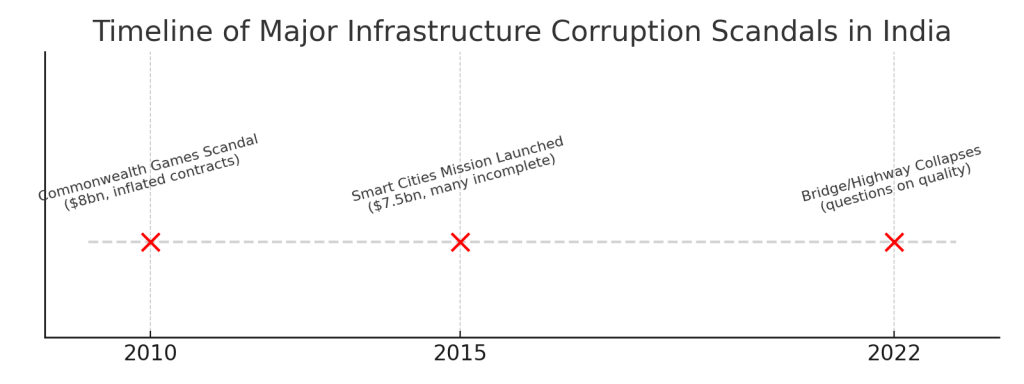
Timeline of Major Scandals
Figure 3: Timeline of Major Infrastructure Corruption Scandals in India
Consequences Beyond Borders
International investors hesitate due to opaque tendering and legal uncertainties.
India’s comparative disadvantage grows as China and Southeast Asia present themselves as more efficient alternatives.
Domestically, citizens view infrastructure not as progress but as proof of systemic rot.
Conclusion
Infrastructure is more than concrete and steel—it is the architecture of trust.
China’s high-speed rail, Singapore’s airports, and South Korea’s smart cities show what transparent governance can achieve.
India has the talent and resources to do the same. But unless corruption is decisively rooted out, its projects will remain monuments not to progress but to graft.
References
- Transparency International. Corruption Perceptions Index 2024.
- World Bank. Global Infrastructure Report: Costs and Governance (2020).
- World Bank. Belt and Road Economics: Opportunities and Risks (2019).
- OECD. Principles for Integrity in Public Procurement (2016).
- Ipsos. Global Infrastructure Index (2023).
- BBC. India’s Commonwealth Games: A National Embarrassment (2010).
- Hindustan Times. Smart Cities Mission: Patchy Progress (2023).
- The Hindu. Bridge Collapse Raises Fresh Questions on Highway Quality (2022).
- PwC. Southeast Asia Infrastructure Outlook (2022).
- Government of India. GeM Procurement Transparency Report (2021).

Leave a comment