
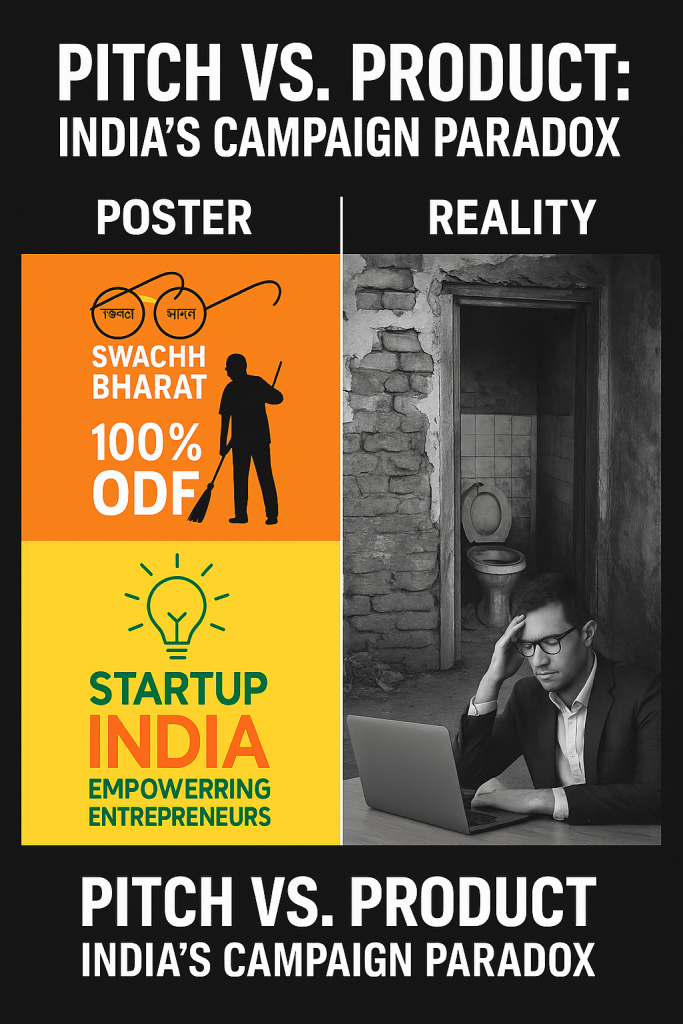

Pitch Without Product: The Perils of India’s Campaign Politics
By Jitendra Kumar Singh
“A good salesman, by orchestrated campaign, can change surface appearance without changing underlying reality.”
— Adapted from Peter Thiel, *Zero to One*
Politicians as Salesmen
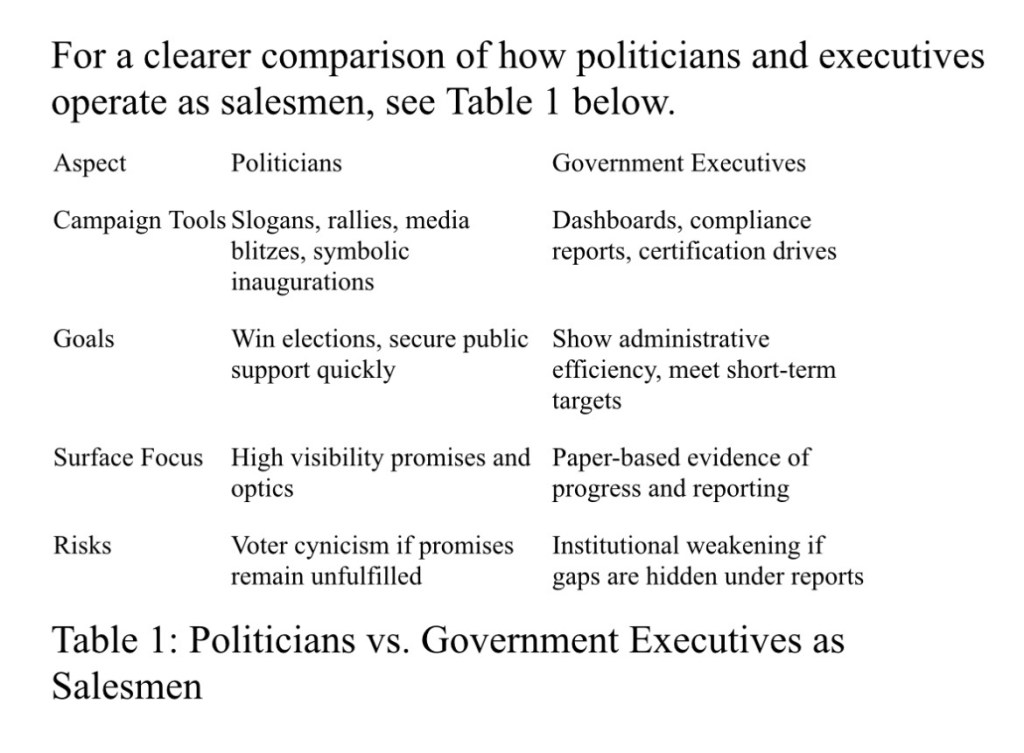
In politics, orchestrated campaigns act like powerful sales pitches:
• Focus on electoral cycles: short-term wins matter more than structural reform.
• Use slogans and symbolism to capture attention quickly.
• Prioritize visibility: rallies, media blitzes, and inauguration ceremonies.
• Risk: Citizens see promises without sustained delivery.
Government Executives as Salesmen
Executives mirror this dynamic in administration. Examples include sanitation drives where toilets were built faster than water systems, infrastructure inaugurations without long-term maintenance, and startup procurement policies that promise access but impose hidden barriers. These cases show how executives master the pitch, but the product lags behind.
Key contrasts for executives:
• Focus on administrative optics: compliance reports, dashboards, and certifications.
• Translate political slogans into bureaucratic campaigns with paperwork.
• Prioritize appearance of efficiency (quick reports, short-term metrics) over depth.
• Risk: Institutional credibility erodes when surface progress hides persistent gaps.
Case Study 1: Swachh Bharat Mission
Launched in 2014, the Swachh Bharat Mission (SBM) promised to end open defecation. The campaign was relentless billboards, dashboards, and certification ceremonies.
The surface:
Official surveys claimed 95%+ toilet usage.
The country was declared ‘Open Defecation Free.’
The reality:
Independent data shows ~75 million Indians still practiced open defecation in 2022–23.
Courts and media flagged broken toilets, water shortages, and weak waste management.
Sustainability—maintenance, water connections, and behavior change lags behind the initial construction drive.
SBM deserves credit for raising sanitation awareness and building millions of toilets. But the campaign’s surface image raced ahead of the deeper systems required for lasting change.
Case Study 2: Production-Linked Incentive (PLI)
The Production-Linked Incentive (PLI) scheme was launched as a manufacturing renaissance, with $26 billion in incentives across 14 sectors.
The surface:
-Mobile phone exports surged, rising from 3% to over 50% of electronic exports in just five years.
Government messaging declared India a ‘global hub.’
The reality:
By 2024, only about 37% of production targets were met.
Incentive disbursal lagged far behind commitments.
Textiles, steel, and solar sectors fell short, with several firms unlikely to meet goals.
Mobiles are a clear success story. But the wider promise of a broad manufacturing revival remains more narrative on the surface than structural transformation.
Case Study 3: Startups
In 2016, Startup India promised to give young innovators a seat at the table.
Policies allowed DPIIT-recognized startups to bypass traditional barriers in public procurement—no prior turnover, no track record, and no heavy deposits.
This aligned India with global best practice:
The US SBIR program reserves billions in federal procurement for small firms.
Israel routinely pilots startups in defense and cyber projects.
South Korea uses procurement to push startups into electronics and green tech.
The surface:
Over 157,000 startups recognized by DPIIT.
30,000+ registered on the Government e-Marketplace (GeM).
Public statements celebrate startup integration into procurement.
The reality:
Some ministries like Railways mention relaxations in their bid documents but add Additional Terms and Conditions (ATCs) that effectively exclude startups, favoring companies backed by powerful politicians and executives.
Other ministries such as MoRTH and NHAI bluntly sidestep the Prime Minister’s vision by imposing criteria that nullify startup participation.
This lets dashboards display implementation success while keeping contracts with established firms.
The result? Since the inception of Startup India in 2016, not a single DPIIT-recognized startup consultancy has been awarded a major ministry contract under the relaxation policy.
Policy promises empowerment, but practice results in exclusion.
The Power of Narrative in Governance
Narratives have become as important as policies in modern governance. Through slogans, campaigns, and orchestrated visibility, leaders shape both citizen perception and global opinion. The power of narrative lies in its ability to mobilize support quickly, distract from slower-moving realities, and create legitimacy even before outcomes are tangible.
Yet, without matching substance, narratives risk turning into empty rhetoric.
The Surface vs. Substance Dilemma
India’s case highlights a broader dilemma for developing democracies: whether governance should focus on the surface—visible actions, announcements, and symbolic achievements—or on substance—long-term reforms, institutional strengthening, and difficult structural adjustments.
Campaign politics prioritizes the surface, while nation-building requires substance.
The widening gap between the two is India’s central challenge.
Lessons from Global Comparisons
Looking globally, successful governance models balance salesmanship with delivery.
The United States, Israel, and South Korea use orchestrated campaigns to rally attention, but they also back them with robust institutions that ensure results.
In contrast, India’s campaigns often remain ahead of its institutional capacity to implement.
The lesson is clear: campaigns can inspire, but only strong systems can sustain trust.
Conclusion
India’s governance today reflects a salesman’s paradox.
The country has mastered the pitch—grand campaigns, bold announcements, and global headlines. But the product—the daily reality of sanitation gaps, incomplete industrial reforms, and blocked startup participation too often falls short.
As Peter Thiel warned in *Zero to One*, salesmanship without substance cannot last.
A strong pitch may win attention, but only a strong product wins trust.
For India, this means moving beyond slogans and ensuring structural reforms carry the weight of transformation.
Ultimately, India will not be judged by the brilliance of its campaigns but by the depth of its delivery.
The world and India’s citizens await substance that matches the slogans.
Deep Seek Conclusion
The salesman state, as applied to India’s governance, raises profound questions about the future of democracy, development, and trust. Campaigns are designed to capture attention quickly.
They thrive on visibility, repetition, and symbolism. Yet governance is a long game. It depends on deep systems, institutional resilience, and reforms that may take decades to mature.
If India continues on its current trajectory, where surface campaigns outpace substantive reforms, the risks are manifold:
• Credibility erosion: Citizens may increasingly dismiss government announcements as propaganda.
• Investor skepticism: International investors and partners look for delivery, not just declarations.
• Institutional weakening: Bureaucracies accustomed to reporting surface achievements may lose the capacity to deliver deeper change.
Yet the opportunities are equally significant if India learns to balance pitch with product:
• Leveraging campaign energy: Campaigns can mobilize attention and resources. If paired with robust execution, they can accelerate reforms in sanitation, manufacturing, and entrepreneurship.
• Empowering startups and citizens: Genuine inclusion of startups in procurement, and citizens in governance, would ensure that reforms touch the grassroots rather than remain elite narratives.
• Global leadership by example: By aligning slogans with structural delivery, India could demonstrate a model for other democracies—showing that campaign politics and substantive governance can coexist.
The deep lesson is this: salesmanship is not inherently negative. Like a startup founder raising capital, a government must persuade, mobilize, and inspire. But when persuasion becomes a substitute for delivery, it corrodes legitimacy.
True leadership uses campaigns not as a mask for inaction, but as a bridge to meaningful action.
India’s story will ultimately be judged not by how many campaigns it launched but by how many lives it transformed. The salesman state can succeed only when the pitch is matched by a product worthy of its promise.
References & Sources
• WHO/UNICEF Joint Monitoring Programme (JMP) – India sanitation data (country profile)
• UNICEF India – WASH & sanitation overview
• Reuters – India PLI performance and payouts coverage (2024–2025)
• Startup India – Public Procurement (startup relaxations, exemptions)
• Department of Expenditure – Procurement Manuals (incl. 2025 Consultancy Manual)
• Office Memorandum – Relaxation of prior experience/turnover for Startups (Govt. of India PDF)
• U.S. Small Business Innovation Research (SBIR) Program
• South Korea Public Procurement Service (PPS) – English portal

Leave a comment