
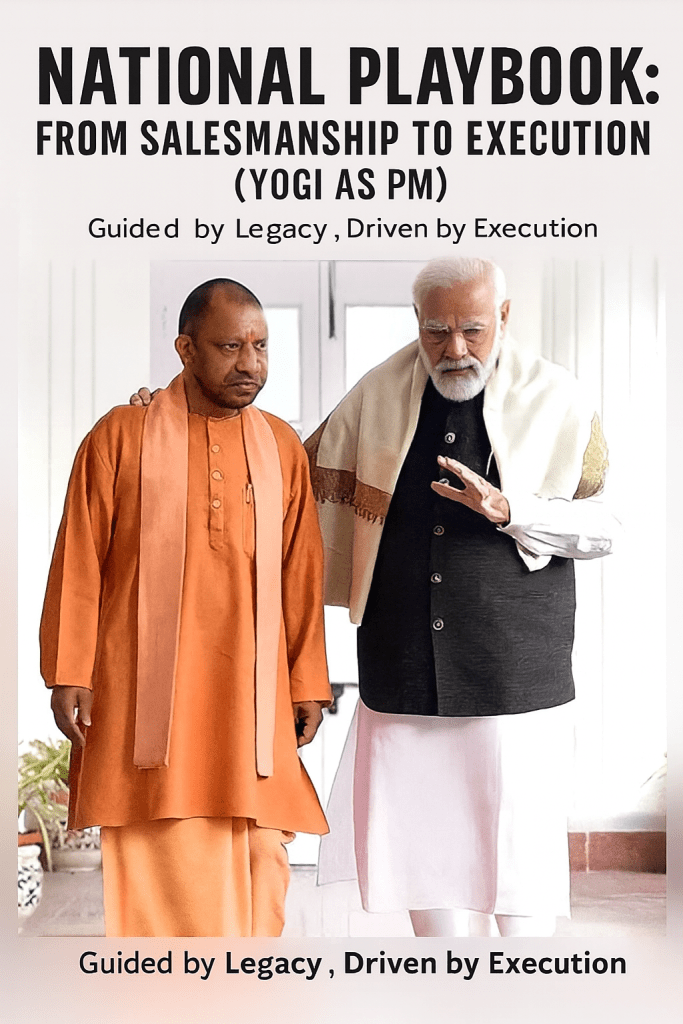
India’s next leap will not come from bigger campaigns but from better clocks and cleaner rules. If elevated to the national stage, Yogi could scale the UP ‘execution OS’—weekly reviews, SOPs, and consequence-linked dashboards—across ministries to end salesmanship and deliver results. This section outlines a PM-level playbook designed for international readers, highlighting how rules, not relationships, can transform India’s governance.
National Playbook: From Salesmanship to Execution (Yogi as PM)
by JK
Guided by Legacy , Driven by Execution
I. The Problem Yogi Would Inherit
• • Salesmanship loops at the Centre: ministries optimise for announcements and dashboards, not verified outcomes.
• • Procurement barriers: Startup relaxations negated by Additional Terms & Conditions (ATCs).
• • Two-track capitalism: preferential access for a few, freebies for the bottom, middle class squeezed.
• • Fragmented accountability: Dashboards rarely tied to promotions, fund releases, or transfers.
II. The Yogi ‘Execution OS’ (Scaled Nationally)
• • Few non-negotiables relentlessly tracked (law & order, core services uptime, welfare usage).
• • Time-boxed review cadence with assigned tasks and deadlines.
• • SOPs + digital rails: model RFPs, e-procurement, DBT, geo-tagged verification.
• • Dashboards with consequences: metrics trigger fund release, movement, or milestones.
III. 10-Point PM Agenda
• • Execution compacts with ministries (100-day and annual KPIs).
• • Procurement integrity: ATC/SCC Amnesty + Open Tender Ledger.
• • Single neutral rulebook for startups, MSMEs, and big firms.
• • Anti-rent architecture: random audits, no-lobby registry, officer rotations.
• • Outcome verification: uptime SLAs, geo-tagged assets, citizen callbacks.
• • From freebies to services: tie subsidies to usage and service reliability.
• • Startup/MSME on-ramp: Green Lane windows, pilot-to-scale programs.
• • Capex as economic plumbing: corridor bundles with synchronised commissioning.
• • Rule-of-law as delivery enabler: contract enforcement fast lanes.
• • International credibility: publish crime, service uptime, learning and health in open data formats.
IV. Equal Eyes: Startups, MSMEs, and Big Business
• • Legal presumption in favour of relaxations; restrictive clauses voidable.
• • Clause library to standardise eligibility terms.
• • Rapid appeal window for bidders to challenge restrictive terms.
V. Middle-Class Fairness
• • Service-first subsidies: rebates tied to uptime failures.
• • Taxpayer dividend: efficiency savings fund middle-class relief.
• • Transparent user charges with annual statements of use and outcomes.
VI. Anti-Corruption: From Slogans to Systems
• • Public Interest API: tenders, contracts, payments as machine-readable data.
• • High-risk mapping: anomaly detection on clauses, bids, costs.
• • Consequences: blacklist offenders, forfeit bonds, rotate officers.
VII. Strengths and Risks
• • Strengths: review cadence, SOP culture, law-and-order predictability.
• • Risks: speed vs scrutiny, box-ticking, Centre–state friction.
VIII. First 100 and 500 Days
• • 100 Days: ATC/SCC Amnesty, Execution Compacts, Green Lane startup lots, open dashboards.
• • 500 Days: corridor bundles let, integrity audits published, startup pilots scaled, rebates operational.
Deep-Seek Conclusion
• • India needs rules, not relationships. One rulebook for all firms, dashboards with consequences, and audits that make truth public.
• • Do this, and India stops selling reform—and starts delivering it.
Rules, Not Relationships
The Current Problem: Relationships Over Rules
India’s central governance has increasingly tilted toward relationship-driven policymaking:
• Selective corporate beneficiaries: Independent analyses highlight how business groups secured preferential access to resources, contracts, and policy environments.
• Startups on dashboards, not in deals: While Startup India boasts over 100,000+ registered startups, procurement relaxations are rarely implemented. Ministries insert Additional Terms and Conditions (ATCs) that block startups, ensuring contracts flow to incumbents.
• Middle-class squeeze: Policy skew creates a dual economy—subsidies/freebies at the bottom, sweetheart access at the top—while the middle class pays compliance costs and endures weak services.
Case Study: Procurement and MSMEs vs. Large Conglomerates
• On Paper: DPIIT’s 2016 circular removed turnover/experience thresholds for DPIIT’s startups Consultancies Services in public tenders.
• On Ground: Ministries like MoRTH and NHAI reinsert impossible clauses (insurance guarantees, global turnover and experience ceilings) that startups cannot meet.
• Contrast: Conglomerates easily qualify under such terms, gaining control in ports, energy, airports, and highways.
How It Would Change Under Yogi as PM
• Clause-level transparency: Any tender clause outside official manuals would need Cabinet Secretariat clearance and public justification.
• Equal rules: Big corporates, MSMEs, and startups can compete under the same eligibility framework.
• Execution over optics: Startup dashboards must be backed by actual startup contracts through pilot-to-scale procurement.
• Neutral governance: Bureaucrats rotated out of relationship-heavy posts; careers tied to metrics, not meetings.
Philosophical Anchor: The Gita’s Lesson
The Bhagavad Gita (Chapter 2, Verse 57) states:
“He who is neither saddened by bad events nor elated by good events, who is free from fear, anger, and delusion—such a sage is firmly established in wisdom.”
Applied to politics: A leader unmoved by fear, anger, or illusion can enforce rules consistently, without bias. Yogi’s reputation for detachment and discipline positions him to build systems where rules—not personal ties—govern contracts, ministries, and business.
Why ‘Rules, Not Relationships’ Matters Globally
For investors, civil society, and India’s middle class, this distinction is the difference between:
• A salesman’s India: grand slogans, few winners, disillusioned citizens.
• An executor’s India: consistent laws, credible delivery, predictable outcomes.
If scaled nationally, the UP model of execution—combined with Yogi’s alignment to the Gita’s teaching—could restore fairness, rebuild trust, and anchor India’s global rise on rules, not relationships.
Mentorship from Modi for Yogi in International Relations
International Briefing Sheet: Mentorship from Modi for Yogi in International Relations
Purpose: Pair diplomatic continuity from Prime Minister Narendra Modi with rule-based domestic execution under a Yogi premiership, via direct mentorship to Yogi.
Key Pillars
• • Continuity with credibility: Build on G20 legacy groups, Quad, I2U2, IPEF, and the India–EU TTC to reassure partners of policy steadiness while tightening execution at home.
• • Deal flow that delivers: Tie international MoUs to domestic milestones—land, clearances, power/port capacity, procurement windows—so announcements convert to assets.
• • Gulf–Indo-Pacific–Africa triangles: Use Modi’s established rapport to bundle finance, logistics, and skills; crowd-in private capital with clear service-level agreements (SLAs).
• • Diaspora as execution partners: Shift from event diplomacy to enterprise diplomacy via diaspora funds and procurement sandboxes for pilot-to-scale programs (healthtech, agri-sensors, edtech).
• • Risk management: Institutionalize supply-chain risk units (energy, food, semiconductors) and public-health readiness to back foreign commitments with buffers and rapid-response protocols.
• • One voice, many channels: Retain Modi as senior envoy for leader-level outreach while Cabinet-led tracks (commerce, power, rail, defense, digital) run quarterly delivery dashboards.
Outcomes for Partners & Investors
• • Lower execution risk: Clearer line of sight from MoU to commissioning.
• • Predictable policy: Rules-based procurement and time-bound delivery increase confidence.
• • Real economy impact: Corridors, co-production, and digital public goods scaled on verifiable timelines.
Signal: Modi’s mentorship to Yogi pairs a familiar diplomatic face with a tougher execution spine—reliability abroad, rule-based delivery at home.
India today stands at a crossroads between salesmanship and statesmanship. For years, governance has too often been defined by campaigns, dashboards, and selective statistics, while the deeper structural reforms lagged. The Yogi playbook—scaled from Uttar Pradesh—offers a different path: one rooted in rules over relationships, execution over optics, and outcomes over announcements.
With mentorship from Prime Minister Modi, Yogi as PM could combine diplomatic continuity abroad with domestic credibility at home. The Bhagavad Gita’s teaching—that true leadership is free from fear, anger, and illusion—captures the spirit of this model: impartial, focused, and resilient. It means treating startups and conglomerates by the same rulebook, enforcing dashboards with consequences, and ensuring citizens—especially the middle class—see benefits in the quality of services they use daily.
The global community will judge India not by the brilliance of its slogans but by the reliability of its delivery. If India moves decisively to replace salesmanship with execution, it can anchor itself as a trustworthy partner for investors, allies, and citizens alike. That is the promise of a Yogi-led, rule-based India—a nation where governance is no longer sold, but steadily delivered.
References & Sources
• WHO/UNICEF Joint Monitoring Programme (JMP) – India sanitation data (country profile)
• UNICEF India – WASH & sanitation overview
• Reuters – India PLI performance and payouts coverage (2024–2025)
• Startup India – Public Procurement (startup relaxations, exemptions)
• Department of Expenditure – Procurement Manuals (incl. 2025 Consultancy Manual)
• Office Memorandum – Relaxation of prior experience/turnover for Startups (Govt. of India PDF)
• U.S. Small Business Innovation Research (SBIR) Program
• South Korea Public Procurement Service (PPS) – English portal

Leave a comment