
Abstract
Infrastructure development is often celebrated as a driver of economic growth and social progress. Yet in many countries, public infrastructure projects display chronic inefficiencies: inflated costs, substandard construction, and premature collapse.
This paper argues that such failures are not merely the result of technical mismanagement but part of a recurring corruption model. By embedding fragility into project lifecycles, political and business elites sustain a “designed-to-fail strategy” that ensures continuous streams of contracts, rents, and political leverage. Drawing on global studies of corruption, procurement, and governance, along with recent case studies, the paper outlines the anatomy of this recurring model, its systemic consequences, and pathways for reform, including the importance of sustainability and resiliency in infrastructure planning.
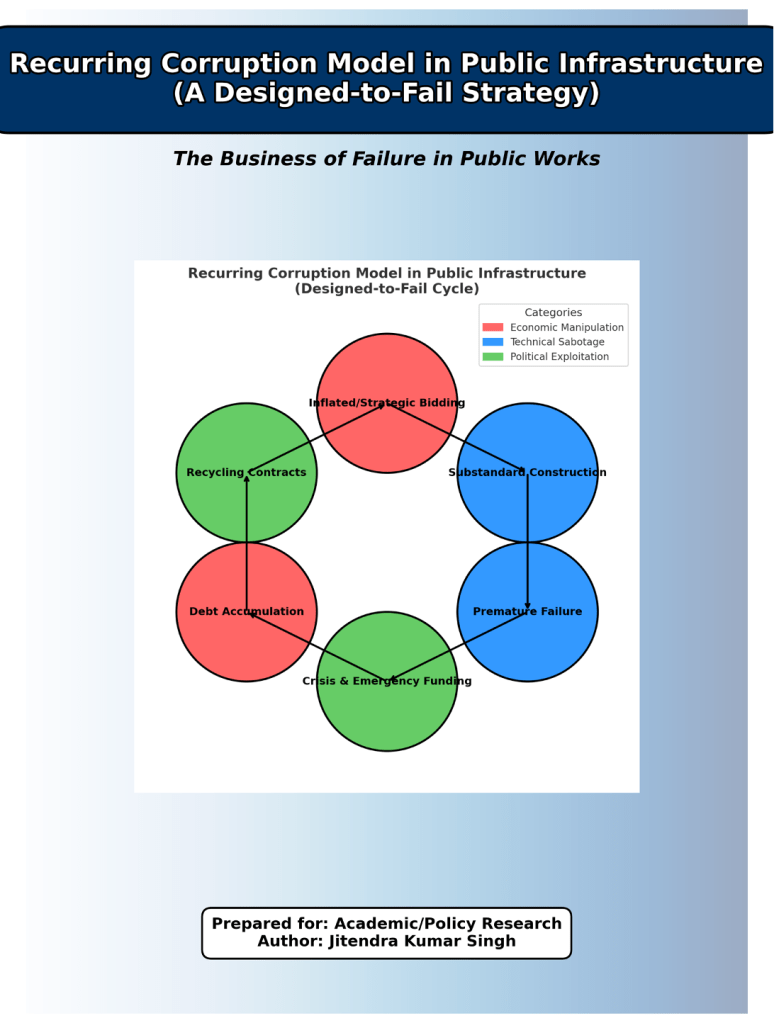
1. Introduction
Infrastructure is central to human development, enabling trade, mobility, and access to essential services (World Bank, 2020). However, infrastructure projects are often plagued by cost overruns, delays, and durability issues. The World Economic Forum (2016) estimated that inefficiencies in public infrastructure cost the global economy trillions annually. In many contexts, these inefficiencies are not accidental—they are structurally embedded in governance systems where corruption dominates.
This paper examines the Recurring Corruption Model (RCM), where infrastructure is intentionally designed to fail, creating perpetual opportunities for extraction. The RCM thrives where state institutions are weak, procurement processes are opaque, and accountability is absent. It also contrasts this model with principles of sustainability and resiliency, which offer pathways to break the cycle of engineered fragility.
2. Literature Review
Scholars have long studied the relationship between corruption and infrastructure. Kenny (2009) demonstrated how bribery inflates costs and reduces quality in infrastructure delivery. Rose-Ackerman and Palifka (2016) analyzed how systemic corruption distorts incentives in public policy. Flyvbjerg (2014) identified strategic misrepresentation and deliberate underestimation of costs in megaprojects. Transparency International (2017) further highlighted how procurement corruption undermines infrastructure sustainability.
This body of research provides a foundation to conceptualize corruption not just as incidental but as recurrent and cyclical—a model engineered to produce failure and reproduce rents. This is evidenced in global scandals, such as Brazil’s Operation Car Wash (2014–2021), which uncovered systemic collusion between politicians and major construction firms to inflate contracts and recycle bribes through public works projects.
3. Anatomy of the Recurring Corruption Model
3.1 Inflated and Strategic Bidding
Contractors and officials collude to manipulate procurement. Inflated bids channel funds into kickbacks, while underbidding ensures renegotiations and cost overruns (Flyvbjerg, 2014).
A prominent example is the Kenya Arror and Kimwarer dams scandal (2019). Over $500 million was borrowed for two dam projects that were never constructed, with contracts awarded to politically linked firms. The case shows how inflated bidding and fraudulent projects create long-term debt without delivering infrastructure.
3.2 Substandard Materials and Workmanship
Projects are deliberately built below technical standards. Substandard materials guarantee early breakdowns, triggering “emergency repairs” that generate new rounds of contracts (Transparency International, 2017).
The Morandi Bridge collapse in Genoa, Italy (2018) illustrates this vividly. Investigations revealed falsified safety inspections, underinvestment in maintenance, and contractor collusion, leading to the tragic deaths of 43 people. This demonstrates how technical sabotage, driven by corruption, can have devastating human costs.
3.3 Regulatory Capture
Oversight bodies are compromised through political appointments, underfunding, or bribery. Instead of ensuring compliance, regulators facilitate the corruption cycle (Hellman, Jones, & Kaufmann, 2000).
In Nigeria, repeated rehabilitation of the Abuja–Kaduna highway has been criticized by citizens as evidence of “contractor–politician cartels,” where regulators fail to hold contractors accountable for poor quality, enabling endless cycles of repair.
3.4 Crisis-as-Opportunity
Infrastructure breakdowns are reframed as unavoidable crises. Emergencies allow procurement rules to be bypassed, reinforcing elite control over new contracts (OECD, 2015).
A recent case is the NH-21 highway collapse in Himachal Pradesh, India (2024–25), where entire sections were washed away by monsoon floods. The National Highways Authority of India (NHAI) declared restoration works on “war footing,” airlifting machinery and deploying emergency contracts. While presented as decisive action,
this aligns with the RCM’s crisis-as-opportunity stage: bypassing scrutiny, fast-tracking contracts, and reproducing rents for entrenched networks.
The lack of focus on resilient design capable of withstanding predictable monsoon floods highlights how the model perpetuates fragility.
3.5 Debt Cycling
Fragile infrastructure requires repeated replacement and repair, financed through loans. This creates a cycle of debt dependency while failing to deliver long-term service provision (UNCTAD, 2021).
Both Kenya’s abandoned dams and Nigeria’s highway repairs exemplify this. Funds borrowed for substandard or incomplete projects become long-term national liabilities, embedding citizens in debt while enriching contractors.
4. Why Failure Becomes the Business Model
The designed-to-fail strategy persists because it maximizes profit and political capital:
- Profitability of Fragility: Durable infrastructure eliminates opportunities for recurring rents. Failure guarantees recurring cash flows.
- Political Theater: Politicians gain visibility from inaugurating new projects while shifting blame for collapse to external factors (natural disasters, climate, sabotage).
- Elite Interdependence: Contractors, bureaucrats, and politicians form self-reinforcing networks that rely on recurrent project failures.
By contrast, building sustainable and resilient infrastructure would disrupt these incentives by reducing the frequency of breakdowns and limiting the opportunities for rent-seeking.
5. Consequences
5.1 Economic Costs
Wasted budgets and ballooning debt undermine fiscal stability. Infrastructure inefficiencies increase transaction costs, slowing economic growth (World Bank, 2020).
Sustainability is undermined when projects fail before delivering their intended economic returns.
5.2 Social Costs
Prematurely failing infrastructure erodes public trust in government and exposes citizens to safety hazards such as collapsed bridges or unsafe water systems.
The Morandi Bridge disaster in Italy demonstrates the devastating social consequences when corruption-driven fragility meets everyday use. Building resilient infrastructure could mitigate such risks by ensuring safety under foreseeable stresses.
5.3 Political Costs
Recurring corruption entrenches state capture, where private interests dominate public policy (Hellman et al., 2000).
The Operation Car Wash scandal in Brazil illustrates how infrastructure corruption can destabilize governments and erode democratic legitimacy. Sustainability and resiliency reforms could reduce political vulnerability by embedding transparency and durability into infrastructure systems.
6. Policy Implications
Breaking the RCM requires systemic reforms:
- Independent Oversight: Establish autonomous anti-corruption bodies with prosecutorial powers.
- Transparent Procurement: Mandate open-access platforms for contracts, budgets, and project progress (OECD, 2015).
- Blacklisting and Penalties: Enforce long-term sanctions on firms and officials engaged in procurement fraud.
- Citizen Monitoring: Empower civil society and media to track project lifecycles.
- Performance-Based Incentives: Reward durability, sustainability, and life-cycle cost efficiency rather than short-term construction milestones.
6.1 Sustainability and Resiliency in Reform
Breaking the RCM requires not only anti-corruption mechanisms but also proactive design for sustainability and resiliency. Infrastructure should be assessed on long-term durability, environmental impact, and capacity to withstand foreseeable shocks. Integrating sustainability standards into procurement, coupled with resiliency benchmarks in engineering codes, ensures that infrastructure investments deliver genuine public value rather than recurring cycles of failure. This approach aligns with global commitments under the UN Sustainable Development Goals (SDG 9 and SDG 11).
7. Closing Summary
The recurring corruption model in infrastructure reflects a systemic strategy of engineered fragility.
Projects are not failing by accident they are designed to fail because failure sustains rents, debts, and political leverage.
The case studies of Himachal Pradesh, Genoa, Abuja, and Kenya show how this model plays out across different governance contexts.
Recognizing this dynamic shifts the policy focus from mere technical fixes to structural governance reforms.
Embedding sustainability and resiliency into procurement and planning frameworks offers a viable pathway to break the cycle, ensuring infrastructure that is not only durable but also socially and environmentally responsible.
References
- Flyvbjerg, B. (2014). What You Should Know About Megaprojects and Why: An Overview. Project Management Journal, 45(2), 6–19.
- Hellman, J. S., Jones, G., & Kaufmann, D. (2000). Seize the State, Seize the Day: State Capture, Corruption, and Influence in Transition. World Bank Policy Research Working Paper No. 2444.
- Kenny, C. (2009). Measuring and Reducing the Impact of Corruption in Infrastructure. World Bank Policy Research Working Paper No. 4099.
- OECD. (2015). Public Procurement Toolbox: Integrity in Public Procurement. Paris: OECD Publishing.
- Rose-Ackerman, S., & Palifka, B. J. (2016). Corruption and Government: Causes, Consequences, and Reform. Cambridge: Cambridge University Press.
- Transparency International. (2017). Global Corruption Report: Infrastructure. London: Routledge.
- UNCTAD. (2021). World Investment Report: Infrastructure and Sustainable Development. Geneva: United Nations.
- World Bank. (2020). Global Infrastructure Outlook. Washington, D.C.: World Bank.
- World Economic Forum. (2016). Shaping the Future of Construction: A Breakthrough in Mindset and Technology. Geneva: WEF.
- BBC. (2019). Genoa Bridge Collapse: Safety Reports and Investigations.
- Hindustan Times. (2023). Himachal Pradesh Rains: NHAI Restores Manali Highway on War Footing.
- Al Jazeera. (2019). Kenya’s Arror and Kimwarer Dam Scandal.
- Premium Times Nigeria. (2021). Recurring Repairs and Corruption Allegations on Abuja–Kaduna Highway.
- Transparency International Brazil. (2021). Operation Car Wash and Public Works Corruption.

Leave a comment