
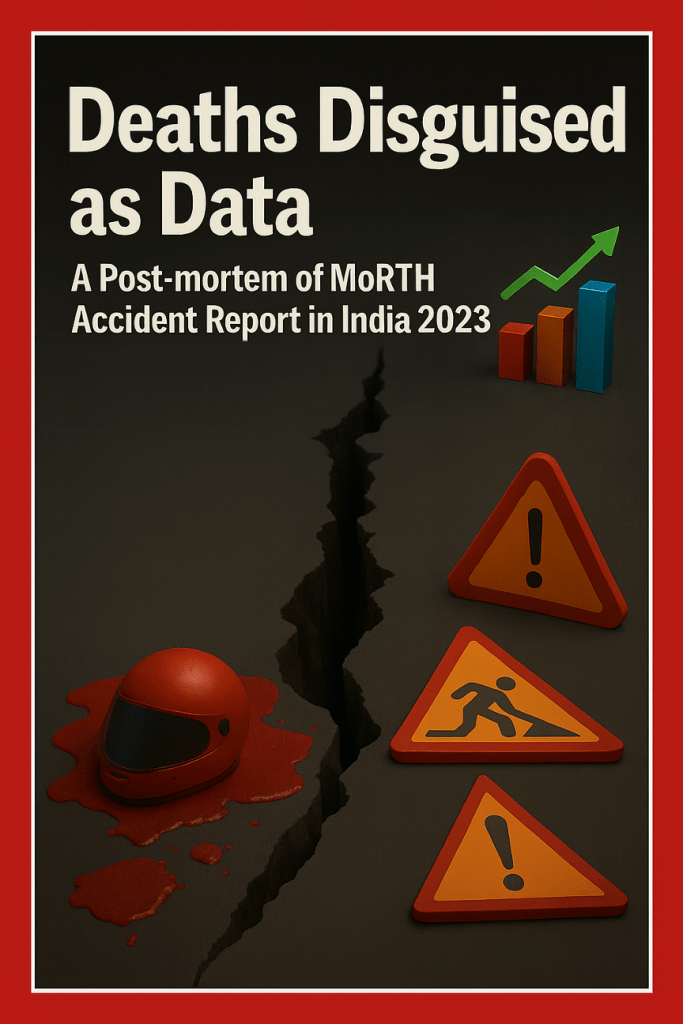
A Post-mortem of MoRTH Accident Report in India 2023
By JK
Executive Summary
This report critically examines the Ministry of Road Transport and Highways (MoRTH) 2023 Road Accident Report, arguing that the Ministry manipulates statistical narratives to deflect accountability from itself, contractors, and consultants, onto road users. Despite recording over 1,68,000 fatalities in 2022, MoRTH continues to celebrate infrastructure growth while failing to address systemic flaws. This dossier exposes contradictions, highlights untreated blackspots, quantifies economic losses, and compares India’s road safety record against international peers. The findings reveal a systemic betrayal of public trust and underscore the urgent need for global accountability.
Introduction: A Nation in Denial
In 2022, India recorded 1,68,491 road deaths (MoRTH, Road Accidents in India 2023, p. 3). This figure places India among the deadliest countries for road users worldwide. Yet MoRTH portrays these deaths as the result of individual negligence rather than systemic failure. Instead of addressing engineering flaws, blackspot management, and enforcement gaps, the Ministry and its ecosystem of contractors and consultants craft narratives that shift the blame onto road users. This is not just statistical negligence; it is a betrayal of public trust and funds.
The Fatal Trio: Ministry, Contractors, and Consultants
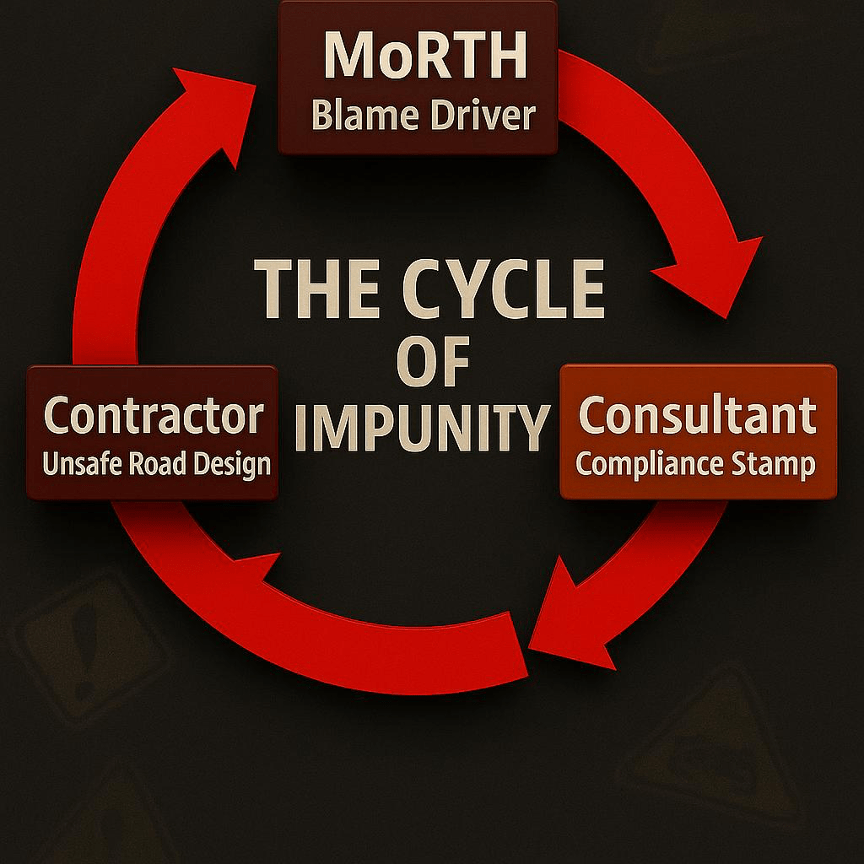
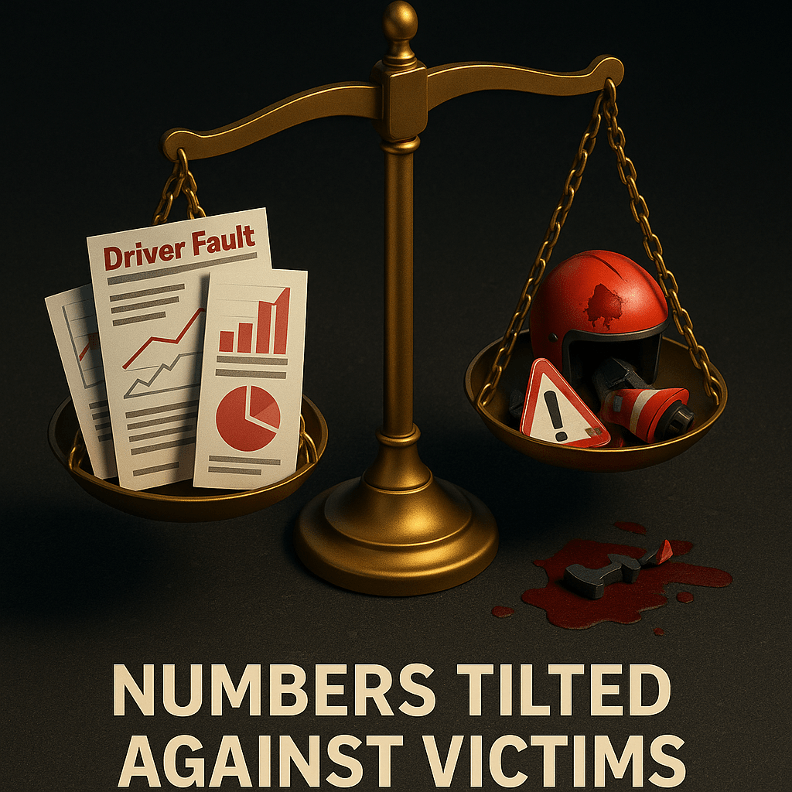
The 2023 MoRTH report repeatedly assigns primary responsibility for crashes to ‘drivers’ fault’ — over 70% of accidents (p. 20). By doing so, the Ministry absolves itself and its partners:
• MoRTH – Oversees road safety but treats fatalities as collateral statistics.
• Contractors – Deliver unsafe highways, poorly engineered curves, inadequate shoulders, and weak barriers.
• Consultants – Certify these roads as ‘compliant,’ yet face no liability when blackspots claim thousands of lives.
This fatal trio sustains a cycle of unsafe design → accident → victim-blame → more contracts for ‘rectification,’ funded by taxpayer money.
Manipulated Narratives: Blame the Dead, Hide the Defects
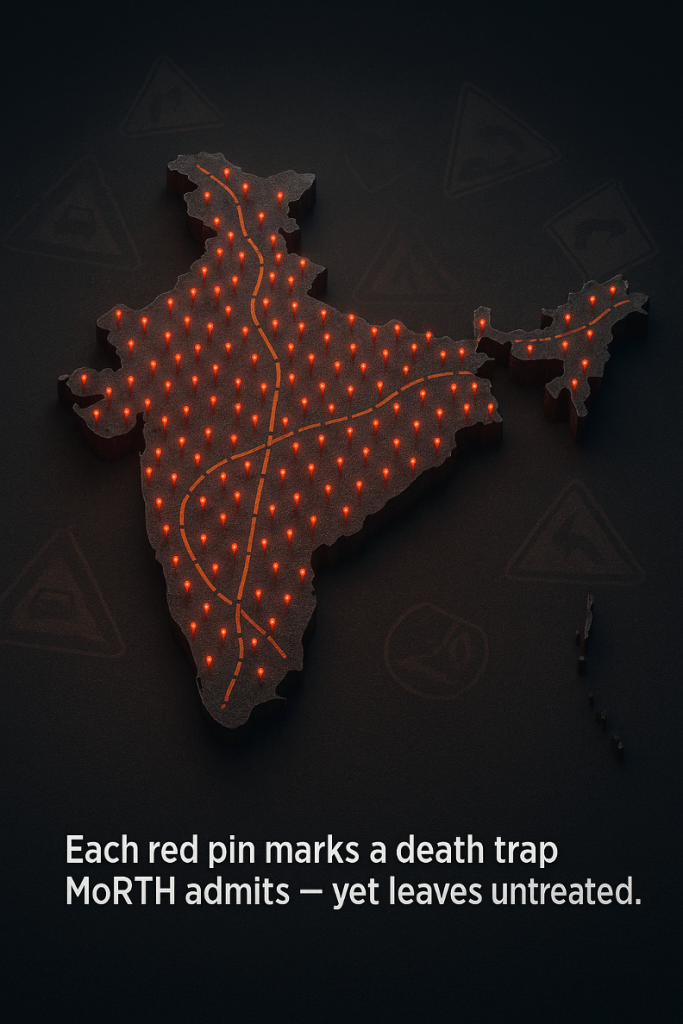
The MoRTH report devotes entire sections to driver responsibility, alcohol use, and overspeeding (pp. 24–32), but dedicates only passing references to engineering deficiencies. Over 5,000 officially identified blackspots (p. 85) remain untreated for years, despite repeated budgetary allocations. Instead of naming contractor and consultant lapses, MoRTH publishes ‘guidelines for road users’ — a public relations smokescreen that transfers accountability from state to citizen.
International Comparison: Evidence of Systemic Failure
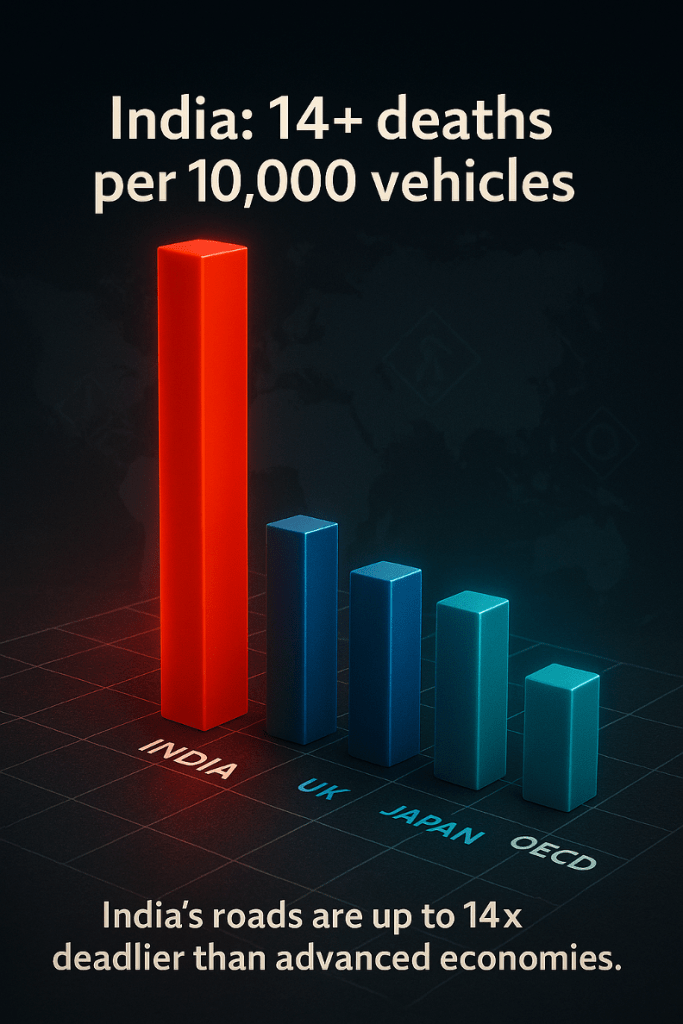
The MoRTH’s own comparative tables (p. 45, Table 3.7) expose India’s dire performance:
• India: 12 deaths per 100,000 population, and 14+ fatalities per 10,000 vehicles.
• UK: 2.7 deaths per 100,000.
• Japan: 2.5 deaths per 100,000.
• OECD average: Below 6 per 100,000.Despite this, MoRTH’s communication strategy cloaks these failures under the ‘bed sheet of progress’ — boasting about increased road length (p. 7) while ignoring global safety benchmarks.
Public Cost, Private Gains
India loses ₹1.8 lakh crore annually in road accident costs (p. 6). This figure includes medical expenses, loss of productivity, and enforcement costs — all borne by the public. Meanwhile, contractors and consultants profit from repeated ‘rectification projects,’ awarded without stringent penalties for non-compliance. Roads are opened prematurely, safety audits are rubber-stamped, and fatalities are simply absorbed into national statistics. This is not inefficiency; it is a systemic transfer of public wealth into private pockets, while the dead are blamed for their own deaths.
Postmarking the Evidence: MoRTH vs. Its Own Data
• MoRTH says: Overspeeding is the leading cause.
• But their own data shows: Over 65% of accidents occur on straight roads (p. 19), pointing to flawed design and poor enforcement.
•MoRTH says: Safety measures are being implemented.
• But their own blackspot report shows: Thousands of hazardous locations remain untreated, year after year (pp. 85–90).
•MoRTH says: Infrastructure is improving.
• But their own comparative tables show: India’s safety record is worse than nearly all G20 peers (p. 45).
These contradictions are not opinions — they are MoRTH’s own admissions, buried in statistical annexures.
The Global Call: End Victim-Blaming, Enforce Accountability
For India to break this deadly cycle, international pressure and scrutiny are essential. The global community, especially multilateral agencies and development banks funding infrastructure, must demand:
1. Transparency in data – independent audits, not ministry-led self-reporting.
2. Accountability for contractors and consultants – penalties for engineering failures that lead to deaths.
3. Alignment with global benchmarks – fatalities must be measured and reduced in line with OECD standards.
4. Prioritization of safety over ribbon-cutting – highways must be safe before being inaugurated.
Roads Must Stop Being Death Corridors
India’s highways should be a symbol of progress. Instead, they are death corridors, where 168,000 lives are lost each year while MoRTH celebrates ‘expansion.’ The world must recognize this crisis not as a matter of culture or fate, but as the outcome of governance failure, profiteering, and institutionalized victim-blaming. Until the fatal trio of MoRTH, contractors, and consultants are held accountable, India’s roads will remain soaked in blood — and its progress narrative nothing more than a dangerous illusion.
Reference
Ministry of Road Transport and Highways (MoRTH). (2023). Road Accidents in India 2023 Report.
World Health Organization (WHO). Global Status Report on Road Safety.
OECD Transport Forum Data on International Road Safety Performance.

Leave a comment